Cowboy Clean Fuels’ New Methodology Combines CDR With Renewable Energy

The following is an article originally published in Carbon Herald on April 28, 2025.

Cowboy Clean Fuels (CCF), a Denver-based company specializing in renewable energy and CO2 technology, has released a new methodology that combines Biomass Carbon Removal and Storage (BiCRS) with Renewable Natural Gas (RNG).

The novel BiCRS+RNG methodology was developed in a collaborative effort with EcoEngineers, a clean energy consulting, auditing, and advisory company recently acquired by leading global assurance partner LRQA.

As part of the collaboration, Eco made sure that the BiCRS+RNG methodology follows the highest scientific rigor, sustainability, and transparency standards, assuring project developers that by adopting this methodology, they will be in compliance with ISO 14064-2:2019.

What the methodology specifically provides is an innovative, industry-first framework that outlines a strict approach for measuring and monitoring, reporting, and verifying (MRV) an innovative decarbonization technology that brings together biogenic methane production with permanent geologic carbon sequestration utilizing legacy energy infrastructure.

BiCRS represents a technology in which carbon-rich biomass is stored underground, keeping it from decomposing and releasing CO2 back into the atmosphere. 

Springing from a proprietary CCF process, the BiCRS+RNG methodology lays out an approach for injecting biomass-derived feedstocks into geologic formations, where it triggers the microbial conversion to carbon and biomethane. 

This process also enables the surface production of biomethane, which can then be delivered to end users as a low-carbon renewable natural gas (RNG).

Through a durable adsorption process, this approach offers a pathway for permanent geologic CO2 sequestration that presents a long-term, scalable carbon solution. 

By aligning carbon removal projects with the highest industry standards, the BiCRS+RNG methodology developed by CCF provides a verifiable pathway for generating high-integrity carbon removal credits, presenting a market gateway for project developers. 

Ryan Waddington, chairman and CEO of Cowboy Clean Fuels, said that the completion of the BiCRS+RNG methodology “represents a major milestone in the evolution of engineered carbon removal and renewable energy production.”

He added, “This methodology enables shovel-ready projects to move forward with confidence, allowing our capital partners to invest with certainty in the Powder River Basin and beyond.”

Optimizing Biogas Revenue At Codigestion Facilities

The following is an article originally published in Biocycle on April 15, 2025.

By Brad Pleima

The U.S. Environmental Protection Agency’s (USEPA) Renewable Fuel Standard (RFS) 2023-2025 Set Rule, released in June 2023, introduced significant opportunities for the renewable natural gas (RNG) and biogas industries. Included in the rule were provisions specific to RNG, referred to as the Biogas Regulatory Reform Rule (BRRR). By allowing the codigestion of feedstocks to generate both D3 and D5 Renewable Identification Numbers (RINs), the rule offers a path to enhanced revenue streams for RNG projects. However, capitalizing on these opportunities requires strategic planning and operational readiness.

A Shift in RIN Calculations

Codigestion refers to the process in which multiple organic feedstocks, such as dairy manure (classified as a D3 feedstock under the RFS) and food waste (classified as a D5 feedstock), are processed together in a single anaerobic digester (AD) to produce biogas. Previously, facilities codigesting non-cellulosic material faced limitations — RNG derived from codigested D3 and D5-eligible feedstocks would default to the lower D5 RIN category.

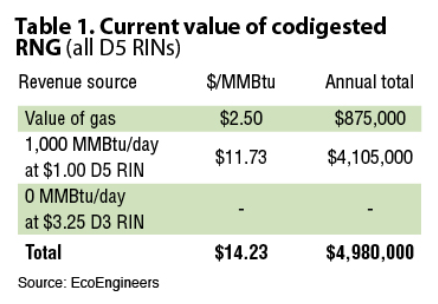
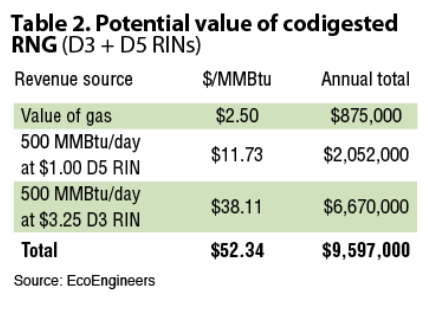
The RFS Set Rule, however, allows for allocating D3 and D5 RINs based on the cellulosic converted fraction (CCF), a calculated measure of the amount of biogas produced from a D3-eligible feedstock. This fraction is critical, as it determines how much of the generated gas can be attributed to each feedstock type, thereby unlocking the potential for higher revenue streams through higher value D3 RIN generation. Tables 1 and 2 illustrate the revenue benefits gained from utilizing the RFS Set Rule for codigestion projects.

The RFS Set Rule allows two methods for calculating the D3-D5 split: a literature-based approach and a site-specific method:

  • Literature-Based Approach: This method uses conservative biogas conversion estimates provided by the USEPA. It relies on predetermined values for the CCF of various feedstocks, such as swine manure, bovine manure, chicken manure, and municipal wastewater treatment biosolids. These values are linked to specific operational conditions, such as a minimum temperature of 95°F and hydraulic and solids retention time exceeding 20 days.
  • Site-Specific Method: This approach allows facilities to establish a custom conversion factor based on historical data and precise measurements of the digester’s operating conditions, including temperature, pressure, and residence time. The resulting CCF is applicable only if the digester operates within these measured parameters.

For facilities with established baselines, the site-specific method can retain up to 90% to 100% of the D3 RIN value, offering a significant advantage over the conservative literature approach, which may only capture 50% of the D3 RIN value.

At this time, there is not a detailed methodology for how to comply with USEPA’s new split methodologies, especially on the facility-specific path. The exact compliance requirements are not known and the industry will learn more as USEPA considers more of these pathways. EcoEngineers, a consulting, auditing, and advisory firm experienced in the biogas RNG space, expects that facilities participating in the USEPA’s RFS Quality Assurance Program (QAP) will have site-specific protocols approved by USEPA to detail future compliance requirements. Established in 2014, the QAP provides a means for ensuring that RINs are properly generated through audits of renewable fuel production conducted by independent third parties. It is a voluntary audit program, but participation is required for AD facilities to get the full value out of a D3 or D5 RIN.

Implementation Considerations

Transitioning to codigestion requires a thorough assessment of biogas and RNG facility capabilities and economic feasibility. Facilities must evaluate their digesters to determine if they can handle diverse feedstocks without compromising efficiency. Essential components include blending tanks for material preparation, adequate mixing systems to maintain digester performance, measurement devices for tracking each feedstock, solids separation or storage infrastructure, and RNG upgrading infrastructure to process the additional biogas generated.

Additionally, digestate management becomes more complex when non-cellulosic materials are introduced. Facilities must account for changes in volume and composition, which could impact disposal methods. For example, dairy farms accustomed to land-applying manure may find new challenges when dealing with a food waste-derived digestate.

Steps for Codigestion Success

  1. Evaluate and Secure Feedstock: Access to consistent and appropriate feedstocks is the first critical step. Without a reliable feedstock supply, projects cannot proceed. For example, a dairy farm might want to partner with local food processing plants to secure a steady supply of food waste, ensuring a continuous feedstock stream for codigestion. Determining potential codigestion feedstocks and biogas potential is a key first step. Importantly, the feedstocks must meet the regulatory definition of “renewable biomass” under the RFS to qualify for D5 RINs. While not all feedstocks are considered equal, “food waste” generally takes a broad meaning under the RFS.
  2. Assess Facility Readiness: Conduct a feasibility analysis to evaluate infrastructure, including blending and digestate management systems, and determine whether upgrades are needed. For instance, a wastewater treatment plant (WWTP) might need to install additional blending tanks and mixing systems to handle the increased volume and diversity of feedstocks.
  3. Evaluate Revenue Potential: Analyze the economic benefits of codigestion. This involves calculating potential increases in biogas production and revenue from RINs or voluntary markets.
  4. Navigate USEPA Approval: Facilities must obtain USEPA approval for their chosen RIN calculation methodology. While the process is outlined in the regulation, no projects have completed this pathway yet, although several are underway, making it essential to work with experts to navigate uncharted territory. To ensure compliance with the RFS program, facilities must also complete a RFS Engineering Review to obtain a revised RFS pathway. They may also want to consider participating in the USEPA’s QAP to verify that the RINs they are generating are valid.
  5. Monitor Market Opportunities: Beyond D3 and D5 RINs, facilities can explore voluntary markets where biogas from codigestion can often command a higher value. For instance, a producer might consider selling its RNG to companies looking to offset their carbon footprint, thereby accessing premium prices in the voluntary carbon market compared to generating lower value D5 RINs.

Who Benefits?

One of the primary economic benefits of codigestion is the increased energy production potential. By adding energy-rich organic waste materials such as fats, oils, and grease (FOG) and food scraps to dairy or wastewater treatment plant digesters, facilities can boost biogas production. Many of these high energy materials can have three to five times the methane production potential of biosolids and manure, leading to higher biogas yields and, consequently, more revenue. Additionally, codigestion can provide economic benefits through potential revenue from tipping fees for accepting food waste.

The use of existing infrastructure for codigestion also contributes to cost savings. Facilities that already have ADs can utilize their excess capacity to process additional feedstocks without the need for significant capital investment in new equipment. This makes codigestion a cost-effective solution for enhancing biogas production and revenue generation and provides a home for problematic feedstocks such as FOG, which clog public sewer lines.

Long-Term Outlook

While the immediate road to implementation may be challenging, the long-term future of RNG and biogas looks promising. In the short term, the biogas industry will need to stay vigilant and proactive in addressing potential regulatory and policy shifts that could impact their business. The industry is navigating a transitional phase due to changing regulations and new markets as biogas/RNG becomes more mainstream. But the 10-to-20-year outlook suggests a smoother path ahead as advancements in technology unlock new potential.

Emerging technologies such as carbon capture and storage (CCS) and smart grids/solar integration are expected to enhance the efficiency and sustainability of biogas projects. This can lead to a lower carbon intensity score, increased production, and lower cost of delivery, among other benefits. The USEPA’s RFS Set Rule is also a step in the right direction for maximizing the value of biogas, whether used for RNG, renewable electricity, low-carbon hydrogen, or sustainable aviation fuel (SAF).

A Call to Action

For biogas and RNG operators, the message is clear: analyze your options. By conducting a thorough feasibility study and assessing operational readiness, you can determine whether codigestion aligns with your goals. Collaborating with industry experts and stakeholders can provide valuable insights into the risks and rewards of this opportunity, ensuring that you have the data to make informed decisions.

For example, the American Biogas Council (ABC) provides resources to help project developers and operators navigate the complexities of biogas production and utilization. Additionally, collaborating with regulatory consultants and leveraging tools like the Biogas Carbon Accounting Tool (CAT) can help facilities optimize their carbon accounting practices and maximize the benefits of their biogas projects.

With the USEPA’s RFS Set Rule in effect, it is timely to maximize the benefits of feedstock codigestion to monetize the full potential of both D5 and D3 RIN values. By taking proactive steps, biogas and RNG facilities can position themselves to capture additional revenue and contribute to a more sustainable energy future.

Brad Pleima is the President of EcoEngineers, a consulting, auditing, and advisory firm recently acquired by leading global assurance partner LRQA. He has more than 20 years of experience in the renewable energy and engineering sectors, working with municipalities, project developers, and investors on anaerobic digestion, biogas utilization assessments, and biogas upgrading projects, and advising clients on global climate regulations, emerging incentive programs, new technologies, evolving carbon markets, data standards, energy credit markets, commodity markets, feedstocks, and carbon accounting rules.

“We Do A Great Job At Helping People Come To Market With Their Carbon Credits” – Roxby Hartley, PhD, Climate Risk Director At EcoEngineers

The following is an article originally published by Carbon Herald on March 31, 2025.

This interview has been edited for brevity and clarity. 

Carbon dioxide removal (CDR) is one of the climate action pillars capable of delivering meaningful results towards global net-zero goals. Paired with CO2 emissions reductions, CDR is a tool that’s increasingly sought after by companies, organizations, and governments as a vital part of sustainability plans. 

Last year, the CDR market experienced an increase in both purchases and deliveries, and the trend of growing carbon removal investments seems to follow into 2025, with relevant industry experts projecting further growth in the future. 

While the interest for CDR is on the rise, experts warn that the current carbon removal levels are still falling behind the benchmarks needed to reach climate targets on time and the CDR sector is in need of rapid scaling to tackle the ongoing environmental crisis.

As the focus of CDR buyers switches from investing in the most affordable projects towards backing high-quality, durable solutions, carbon removal integrity and effectiveness emerge among the top priorities driving carbon removal purchases. 

To ease suppliers with the task of verifying their activity against high-quality standards and generating trustworthy CO2 removal credits, clean energy consulting, auditing, and advisory firm EcoEngineers has put together a paper offering guidance on the auditing process. 

Recently acquired by leading assessment and certification specialist LRQA and accredited by the American National Standards Institute (ANSI) National Accreditation Board (ANAB), EcoEngineers is a US-based company that also boasts established capabilities in the EU market, where it partners with auditing teams following regional rules and regulations.

Authored by Roxby Hartley, PhD, climate risk director at EcoEngineers, the paper titled “Five Requirements for High-Quality CDR Audit” outlines the main areas of focus for performing credible CDR verifications.

The five building blocks of the suggested framework include understanding the audit hierarchy, aligning assurance levels with claims, embracing the dynamic nature of audits, choosing competent auditors, and promoting transparency.

This practical approach stems from years of robust experience in guiding CDR projects to meet the highest standards of integrity and transparency. Following these steps with optimal accuracy enables carbon removal suppliers to confidently audit and verify projects in accordance with rigorous market standards.

In a recent interview with Carbon Herald, Dr. Roxby Hartley shared more about the paper and the intricacies of auditing CDR projects. You will find our conversation below.

Can you tell us more about the paper? It stems from EcoEngineers’ vast experience with its client base, right? 

That’s correct. EcoEngineers started as an audit company, and we have been auditors for the U.S. Environmental Protection Agency (EPA) for over 15 years. We audited around a quarter of all the Low Carbon Fuel Standard (LCFS) pathways in California. So we’ve got a lot of experience on the compliance side.

Recently, we’ve been exploring the new carbon removal space. We see that there are many brilliant people bringing great ideas to life. However, they lack experience in auditing.

An audit is a specific process for verifying claims, and we felt that we needed to provide guidance on how to approach it effectively. This is how you should go about it, and these are the common mistakes to avoid. 

Do you mind walking us through the five requirements for high-quality CDR audits? 

Firstly, many organizations’ project leaders will come to us and ask us to check their systems to ensure that what’s being done is correct, and at a very basic level, it isn’t. 

A specific hierarchy is being developed about how you should document what you’re doing.

At the highest level of the hierarchy, we have the ISO standard, the international standard. We have registries that have interpreted specific ISO standards to develop their own standards. These standards might include more or less sustainability requirements, but they’re typically based on ISO. 

Next, you do is design a methodology. A methodology lays out what you should do in a project to generate carbon credits. If you tick all the boxes, you can get carbon credits. 

Once a project aligns with the hierarchy, adheres to the methodology, and complies with the ISO standard, the next step is to have it verified. This process occurs before you generate any credits, ensuring that your project satisfies all the requirements of the methodology and that the methodology fulfills all the necessary standards.

RelevantLRQA Acquires EcoEngineers, Expanding Low-Carbon Expertise

And then, right at the very end of this, you have the verification of credits, where you say, for example, “We’ve generated 400,000 metric tons of credits over the last year, and we would like that to be audited.” So you invite an independent third party to come in and make sure that the claim is correct.

All categories of claims are made against a document that outlines the boxes you must tick to ensure you can make the claims. That’s your audit hierarchy. We do not audit in a vacuum. We always audit against something that tells us whether they’re doing something correctly. 

The paper also points out the importance of transparency. What steps should CDR suppliers take to ensure everything’s transparent?

That’s actually quite a sticky problem in many situations.

The registries often have very high transparency requirements, which is beneficial because it facilitates a high-quality audit by providing access to all the information. It also means that you’re presenting a wealth of interesting data regarding these novel processes. Furthermore, there is ample opportunity for analysis to enhance the methodology. 

We can enhance our understanding of science by examining all the data available to everyone. Any scientist can come along and analyze the data, suggesting improvements for the scientific processes. The challenge arises when the project proponent, typically the individual undertaking this valuable work, depends on external sources for information.

One classic example in the fuel space is used cooking oil or UCO, which a fuel plant uses to make fuel. If the people supplying that used cooking oil are reluctant to share their information, we can’t pass an audit. 

You need a trusted auditor who will be transparent with all the parties. Still, there are cases where you won’t have a lot of information, and often, it’s because a fuel producer will also be competing against a UCO collector and buying from them at the same time. The UCO collector doesn’t want to disclose all their used cooking oil sources to somebody who could just call the restaurants themselves.

When writing supply contracts, you should include language to ensure your auditor can review all your data to get reasonable or limited assurance that what you say you’re doing, you’re actually doing. Or you’ll apply a penalty if you do not allow the auditor to review that information. If not, you’ll fail your audit, or you will probably have a finding against you that you can’t mitigate.

Are there roadblocks that suppliers should be prepared for when trying to go through the auditing framework? 

There might be gaps. This is why we talk about auditor competence. Auditors usually rely on a clear list of instructions with boxes that need to be ticked off, making sure everything meets the methodology requirements or the credit generation requirements.

The problem comes when the methodologies are new.

For example, the California Air Resources Board’s LCFS regulation could be considered analogous to a methodology. It has very detailed instructions and is backed up by a large staff that interprets those instructions for new projects.

So you bring a project to the California Air Resources Board, and they will go through it in detail to ensure it fits the regulation. When a project comes along that has a novel process, CARB builds specific operating conditions into the project so that it meets the regulation.

The methodology lacks information and, in some cases, expertise. California has a large staff of very experienced modelers who understand greenhouse gas emissions. Still, this expertise is sometimes not available, or the methodology writers fail to recognize that best management practices must be used, which are not reflected in the project. Consequently, skilled auditors must point out that this isn’t correctly written; this project must have the following operating conditions that have not been implemented. That’s where the project is at the validation stage. If you go through a process, can this meet the methodology? Yes. 

It could be as simple as a transportation emissions model that is overlooked. There are numerous transportation emission models, but you might select one that isn’t pertinent to your project, or you might decide on a method that renders it unusable for your project. A classic example is if I’m managing a fleet of trucks, it’s very easy to calculate my emissions because I know how much fuel I’m purchasing. For all the fuel used in the fleet of trucks, I can account for the fuel that goes into the fleet.

I’m taking this into account, and these go from A to B, but that doesn’t capture all the fuel used in that transportation.

However, it is important to consider all surrounding factors, and it is advisable to use an average emissions model rather than a model solely based on direct fuel-related emissions. This reflects an understanding of the life cycle assessment (LCA) modeling. It’s very tricky and sticky. EcoEngineers has ten Ph.D.s on staff in LCA modeling who are excellent at pointing out mistakes like these. An experienced modelers is essential to building out an LCA model. 

EcoEngineers is one of the accredited Validation and Verification Bodies by the American National Standards Institute (ANSI) National Accreditation Board (ANAB). Can you tell us more about the significance of this accreditation?

ANAB is an auditor of auditors. It requires us to have very high documentation standards internally and training of all our auditors. We are audited on our audit process by them.

There’s a particular process you go through with an audit. You take the document and do a risk analysis, which is verification. You say, “Of all the things I’m going to be looking at in your project, which are the ones that can go wrong, and which ones will have the most impact?” And it could easily go wrong, and it will have a huge impact. I want to ensure that all the data is right.

For instance, when there are a hundred farms supplying biomass to this project and I have bills of lading demonstrating their activities, they maintain a good documentation trail, providing me with reasonable assurance. I might choose to visit one farm out of the hundred, but I’m not going to visit all of them, so my sample size remains small. However, if I go to that farm and discover that what they claim to be doing is incorrect, then I would expand the sample size. Thus, we follow a very structured process, and ANAB comes in to verify each step we’ve taken.  We conduct an internal review, and also occasionally, we’ll be audited to make sure that our audit process, our documentation, and what we’re recording about the audit are correctly laid out.

What specific services does EcoEngineers offer to suppliers? 

We offer all services on the audit side. This includes California’s LCFS, Canada’s CFR, Oregon CFP, 45V, M-RETS, as well as custom audits, MRV protocol creation, agricultural emissions verifications, Isometric, Puro.earth, Green-e, and Scope 1, 2, & 3 emissions reporting verification. We do a lot of quality assurance protocol (QAP) audits, which is a program for the EPA. We offer a wide range of services, and we can offer validation services, which include checking over projects before they generate credits or checking over methodologies before they’re accepted to a registry. 

And then, we can do the verification audit for carbon credits at the end on the audit side.

On the consulting side, we can write all those documents in preparation for the audit. We write methodologies for clients, and we write project plans for clients against methodologies. We feel like we do a really good job at helping people come to market with their carbon credits.

Besides improved auditing, what else needs to happen to catalyze the development of the CDR sector?

Some market trends are occurring right now. If you visit the EPA website for class VI wells, there are, I believe, 20 class VI wells that will become operational over the next two years. 

This is in the US, and that doesn’t include North Dakota, Louisiana, or Wyoming. Those wells can store 100 million metric tons of carbon each. In the next two years, two gigatons of carbon storage will come online in the US. 

If you look at the amount of storage coming online, all those storage companies are going to be competing for carbon dioxide. They want the projects to go forward and profit because they’ve put a lot of capital into developing them. And so there will be many people trying to sell CO2 because the 45Q tax credit means it’s pretty lucrative to store CO2.

I suspect that storage will start, and the oversupply of storage will drive carbon capture, particularly in the southeast of the US, both in the CDR and in the avoidance markets.

Read moreDOE Considering Funding Cuts For The Two Largest DAC Projects In The US

There are also some in California. Elk Hills, California Resource Corporation, is going forward with its big capture project in Southern California. A lot of storage is coming online, and people will match it with capture. 

This development of carbon capture at point sources is also going to help all the CDR companies that are looking for direct air capture (DAC), which removes CO from the air and then stores or reuses it, and other technologies where they’re capturing CO2 and putting it underground.

They’ll find that storage is very cheap and easily available. The problem we have with, say, DAC is where to get the energy. These are highly energy-intensive programs, and they won’t work with grid emissions.

If you look at the carbon intensity of the grid emissions per kilowatt-hour, you won’t be able to make those projects carbon negative.

So, you have to find sources of renewable energy, such as solar and wind energy. But all those solar and wind power projects are going forward anyway.


How Urban Centers Can Identify and Mitigate GHG Emission Hotspots Within City Services

The following is an article originally published on Energy Central on March 17, 2025.

Urban centers across the United States (U.S.) face increasing pressure to curb greenhouse gas (GHG) emissions from public services such as transportation, waste management, and utilities. While many municipalities are waiting for future technologies like clean hydrogen and electric vehicles (EVs) to scale, practical solutions exist today that can significantly reduce emissions. By identifying GHG emission hotspots and implementing proven strategies, municipalities can adhere to existing or new climate action plans (CAPs), enhance resilience, and demonstrate leadership in sustainability.

Identifying and Assessing GHG Hotspots

The first step in reducing GHG emissions is to assess what can be quantifiably tracked and measured within the service departments. This does not include supply chain management, which focuses on the production and distribution of goods beyond city service control. GHG inventories can also be a useful tool for quantifying GHG emissions at the municipal operations and community-wide scale. Once a CAP sets an overarching GHG reduction target aligned with the inventory, more detailed GHG quantification can then occur at the project level for planning and implementation. 

Common areas for identifying and evaluating GHG hotspots include:

  1. Transportation 
    Fleet emissions are often among the largest contributors to GHG emissions. Traditional diesel and gasoline vehicles are a significant source of GHG emissions from public transportation systems and waste management, street departments, emergency services, and others. Additionally, fuel costs are often unpredictable and have grown significantly over the past several decades.
  2. Waste Production 
    Landfills and waste management systems release significant GHG emissions. Studies from the U.S. Environmental Protection Agency (USEPA) have recognized these sources contribute to urban pollution and are likely to become more heavily regulated and monitored for compliance.[1]
  3. Energy Use
    Energy delivered to cities throughout the U.S. generally is delivered and managed by complex infrastructure that is expensive and challenging to replace and expand. Utilizing existing natural gas, electric, and steam infrastructure fueled by renewable sources effectively reduces these emissions without significant capital investment. Technologies such as Geographic Information Systems (GIS) and data analytics tools can be employed to visualize GHG emissions and identify emission-intensive sources. This process enables cities to create detailed maps of their city services, pinpointing specific suppliers, transportation routes, or operational sources that require targeted interventions. Key indicators to focus on include energy consumption, waste production, and transportation emissions.

Proven Technologies and Programs for Immediate Action

Urban centers and municipalities can implement various solutions to reduce the environmental impact of city services, including:

  1. Transition to Renewable Energy Sources
    • Encourage fuel suppliers to switch to renewable fuels such as renewable natural gas (RNG) to power fleets or utilities.
    • Leverage waste-to-energy programs to integrate municipal waste management with traditional energy generation.
  2. Optimize Transportation Routes
    • Use low-emission vehicles, such as electric trucks or RNG-powered fleets, and streamline logistics to reduce transportation emissions.
  3. Waste Minimization and Recycling
    • Promote circular economy practices and implement zero-waste programs to reduce emissions from waste production.

Case Studies: Municipalities Leading the Way

Several cities across the U.S. have successfully implemented these strategies, demonstrating their feasibility and benefits.

  • Des Moines, IA: Des Moines has effectively integrated waste management with energy generation by expanding its waste-to-energy facilities. The Des Moines Metro Methane Recovery Facility at the Metro Park East landfill captures landfill gas, primarily methane, and converts it into electricity. An expansion completed in 2013 increased the plant’s energy capacity from 6.4 megawatts (MW) to 11.2 MW, supplying clean electricity to approximately 11,200 homes.[2]
  • Dallas, TX: Dallas has taken concrete steps toward emission reductions through energy optimization as part of its Comprehensive Environmental and Climate Action Plan. The city is committed to reducing GHG emissions by 50% and improving energy efficiency by 20% across its portfolio of 140 facilities over the next 10 years. Strategies include maximizing energy efficiency, decarbonizing buildings, transitioning fleets to electric and low- or no-carbon fuels, and installing renewable energy systems and other innovative technologies across its facilities.[3]
  • Sioux City, IA: Sioux City has adopted innovative approaches to reduce emissions through its Renewable Fuels Project at its Wastewater Treatment Plant. The facility recovers methane and carbon dioxide (CO2) produced through wastewater treatment and converts it into RNG. This RNG is then used as vehicle fuel, creating new revenue streams, and supporting the city’s vision for a healthier environment.[4]

These examples highlight the immediate economic and environmental benefits municipalities can achieve by adopting proven solutions. Additionally, CAPs can help guide these efforts by identifying cost-saving and revenue-generating opportunities through energy efficiency and production, ultimately contributing to their long-term financial sustainability in the most cost-effective way possible.

Municipalities can choose between self-managed programs or outsourced solutions, with both options offering flexibility and financial benefits. Transforming emission-heavy operations into revenue-enhancing programs is a viable and sustainable approach.

Long-Term Climate Goals: Bridging the Gap

Immediate actions taken today can lay the groundwork for achieving 2050 net-zero targets. By implementing available technologies, urban centers can avoid the pitfalls of waiting for unproven solutions. The steps and case studies described above not only ensure measurable progress today but they also provide a strong foundation for achieving long-term climate strategies.

Urban centers must act now to identify and mitigate GHG emission hotspots within their city services. Proven technologies and strategies are readily available such as RNG or electrification, enabling cities to achieve both environmental and financial benefits. Municipalities are encouraged to implement these solutions today, setting the stage for achieving their net-zero and climate action goals. 

About the Expert

Dave Lindenmuth is the managing director of RNG services at EcoEngineers. With over 20 years of experience in the energy industry, he specializes in renewable project development, business strategy, and compliance readiness. For more information, contact Mr. Lindenmuth at dlindenmuth@ecoengineers.us

Why Nuclear Power is Key to AI and Carbon Removal

The following is an article originally published by Sustainability Magazine on March 6, 2025.

By Jasmin Jessen

Today’s energy demand is big — and it’s only going to get bigger. 

Electrified transport, high-performance computing and data centres all need energy to achieve their decarbonising potential, but using high carbon power sources could cancel this out. 

EcoEngineers is an advisory and audit firm that focuses exclusively on the energy transition. 

Its services include asset development, life cycle analysis, compliance management and regulatory engagement.

Roxby Hartley is the Climate Risk Director at EcoEngineers, working between regulation, methodologies, science and markets. 

Roxby Hartley, Ph.D., Climate Risk Director, EcoEngineers

He writes market reports, develops methodologies for new carbon removal technologies and is based in California, USA. 

Roxby shares his expertise with Sustainability Magazine.

Why is energy consumption increasing so dramatically?

A lot of that has been driven by data centres. 

At the moment, we’re seeing announcements from Google, Meta, and Microsoft about nuclear power

As we try to switch away from transportation fuels, we will see more and more electrification of transport — so there’s an awful lot of energy that’s required just to drive people around and move goods around. 

Both of those are the two big drivers.

Why can’t we rely on renewable sources for this?

The demand is growing too quickly. 

One of the claims that many companies want to make is that they’re going to be net zero or carbon neutral. They want to say that the energy they’re using is from renewable sources and has very low carbon intensity. 

Now, if you apply traditional additionality rules to that, you can say that you’re going to build a new solar farm and apply that to a data centre, for example. The problem is that there’s an awful lot of demand now for that renewable energy.

The issue is something called leakage. If you assign that power to a new data centre rather than towards grid decarbonisation, you’re taking from Peter to pay Paul. You are not decarbonising the grid, just simply saying that this person has zero or low carbon electricity, whereas the overall emissions profile hasn’t changed.

If their corporate goal is to decarbonise their data centres, they can’t do so by claiming that they’re allocating traditional renewables to their energy demand.

How could nuclear help?

Building new nuclear facilities or keeping nuclear facilities open that are slated to be closed is a way to show true additional. 

There’s no competition for resources around solar, wind farms, land, permitting or the contractors to build those facilities — it is completely new and therefore there’s no argument about whether it’s additional or not. 

If you want to make a claim that you are using a low carbon electricity, then nuclear is a very good way to do so. 

What about carbon capture? 

You can’t have a boom in carbon removals without having energy sources that are very low carbon. Otherwise you are not helping the environment — you’re just adding to the pile of energy demand that’s going to come from natural gas or whatever fossil fuels have been consumed. 

It’s not so much that we need the energy to come from somewhere where there are very few emissions. It doesn’t really matter where it is, as long as it’s not something that’s already going to decarbonise the grid.  

Download our report, “Powering AI: Additionality and Nuclear Power,” by clicking on the thumbnail below to explore how nuclear energy is shaping the future of clean power for AI and CDR technologies.

Reconfiguring The Flow

The following is an article originally published by Ethanol Producer Magazine on February 11, 2025.

The 12-month results for Fluid Quip Technologies’ trademarked Low Energy Distillation and Grain Neutral Spirits systems are in. After more than a year in operation at Three Rivers Energy in Coshocton, Ohio, both bolt-on technologies outperformed initial estimates, according to Michael Franko, FQT’s vice president. 

The LED system—designed to reduce process energy steam usage by reconfiguring distillation flow without relying on a membrane-based approach—was initially estimated to reduce steam usage per gallon of ethanol by 47% from the industry average of 14.5 pounds per gallon.  

“The project has exceeded these goals and continues to exceed expectations,” says Eamonn Byrne, chief operations officer at Three Rivers Energy. The Coshocton plant was one of the first in the U.S. to deploy FQT’s LED and GNS set-ups, and according to Franko, FQT’s team has more than proven its ability to help ethanol producers reduce energy consumption and lower carbon intensity (CI) scores by reconfiguring distillation. 

“The LED approach brings a lot of opportunities to the plant,” Franko says. “We see a significant expansion of this technology throughout the industry for its ability to lower CI.” 

The LED and GNS systems partner well together, allowing access to new markets, as LED provides the added ability to produce high-purity alcohol (HPA) products through a revamped distillation setup. 

Since 2019, a handful of ethanol producers have added GNS or other HPA production capabilities, most of which were designed to serve the hand sanitizer market. McCord Pankonen, service director of the ethanol and biodiesel divisions for EcoEngineers, says it makes sense for producers to invest in GNS or HPA production. He says the expected growth rate in HPA use in the next five years will range between 5% and 10%.

“A lot of people ask me why an ethanol producer would invest in HPA,” Pankonen says. “It is to diversify their portfolio.”

LED Efficiency 

The opportunity of LED lies in its ability to cascade steam in a smarter way, Franko explains. “It utilizes the steam more efficiently. Many plants are using 20-year-old distillation technology. LED is a newer, proven distillation technology to operate more efficiently with lower cost.”

The LED process can lower a plant’s CI score by 4 to 6 points and cut steam usage by up to 50%. The system also eliminates the need for clean-in-place related downtime. Throughput could also be increased and water load reduced.

In traditional distillation processes, steam is used to boil the combination of fermented ethanol and water. The process allows the ethanol vapor to separate from the water. Directly injecting new or recycled steam into distillation helps control the temperature of the steam, which allows optimal ethanol separation from the water-ethanol mix.

Franko says the ethanol industry typically employs three methods of distillation: pressure distillation, vacuum distillation and hybrid distillation. Pressure distillation relies on two or more columns operating at different pressures in order to separate the water-ethanol mixture. Vacuum distillation utilizes a beer column, rectifier column and a stripper column, where steam is injected to separate the last of the ethanol after it has gone through the other columns. During that process, the injected water then must be removed downstream, increasing CI.

The LED system can be incorporated into either distillation design by eliminating the need for direct injection steam through a series of equipment changes, reengineering or rearranging flow patterns. Franko and his team refer to the changes as “distillation reclaim opportunities.” 

The goal of LED is to arrange the hottest temperature and highest pressure on the cleanest fluids while reusing energy in multiple effects. Unnecessary phase changes are historically one of the largest users of energy in distillation, but LED removes them. This adjustment, while significant in the amount of energy conserved, is simple and operates similarly to existing distillation systems.  

“This modern technology utilizes proven distillation principles, without a need for expensive replacement parts/membranes,” Franko says.

In some cases, an additional beer column will be added along with new reboilers. If the goal is increased ethanol production, molecular sieve capacity may also need to be increased. LED provides a great opportunity for low-CI expansion. The addition of reboilers, beer columns or molecular sieves are the main capital costs related to equipment additions, Franko says. “Changing a plant to an LED style setup should take roughly 12 months total project time, with minimal downtime, usually falling within a plant’s normal shutdown schedule.

“LED may be a unique operational setup, but it is not something new in a plant that they haven’t seen before,” Franko adds. “You just have to get the team to understand the different flow patterns.” 

When Franko talks with prospective producers about the system, he says they often understand the process changes immediately and can envision how an LED system would work at their respective plants.

Past and Future of LED 

The origins of LED link back to FQT’s work with two ethanol plants in Brazil. According to Franko, the FQT team, supported by Thermal Kinetics, helped the Brazil plants reduce energy consumption by using waste low-pressure steam.

The set-up endeavored to meet the needs of the biomass boilers, while maintaining the functionality of the distillation process. At a Sao Martinho plant in Brazil, the team integrated its LED system in conjunction with a mechanical vapor recompression technology to achieve what FQT says is one of the lowest steam-usage rates in the entire ethanol industry.

John Kwik, executive vice president of FQT, called the LED setup, “a real technology disruptor for the South American ethanol market.” 

Agenor Pavan, chief operations officer of the Sao Martinho plant, said the LED system has allowed the plant to avoid investing in additional steam generation or biomass feedstock volumes needed to power its boilers.

Since commencing operation of its LED system at Three Rivers Energy, FQT has had several interested parties tour the facility to see how the system works and what it looks like, Franko says. 

Gevo is already configuring its planned Net-Zero 1 ethanol plant in South Dakota around LED with a focus on driving the CI value as low as possible, Franko says. Once built, the plant will feature—and rely on—FQT’s LED system integrated with mechanical vapor recompression. Having LED at the center of the Net-Zero 1 plant is a testament to the power and ability of its design and FQT’s engineering prowess, Franko says. 

“We are engineering [Net-Zero 1’s] LED system for what we believe will be the lowest-CI ethanol plant in the world,” he says. 

For existing ethanol producers that know they can benefit from investing in CI-lowering technology, the LED route is clear, according to Franko. The advantages are there, and the CI-reduction has been proven.

Growth in GNS, HPA Markets 

Reconfiguring the distillation flow at an ethanol plant can also create more opportunities in the GNS and HPA sectors. 

The FQT team says a plant can use additional steam not utilized in the LED system to produce an HPA steam product. Three Rivers Energy was already working with Gojo Industries to supply HPA for hand sanitizer. According to Franko, although GNS capabilities can be added to a plant’s distillation setup at any time, the move might not always make sense without a clear vision of the end market a plant might serve.

Canada-based Greenfield Global and ClearSource, a division of New York-based Western New York Energy, are two ethanol producers with large investments into HPA and GNS. 

In 2023, Greenfield Global added 30 million gallons of grain-based HPA production to its Johnstown, Ontario, distillery. The company has a global footprint in ethanol production, along with HPA used for spirits, academia, pharmaceuticals and hygiene customers.

ClearSource has more than 600 feet of HPA distillation spread throughout four towers, the tallest at 168 feet tall. ClearSource produces GNS by distilling the alcohol up to seven times to make what it believes is the purest offering on the market. 

EcoEngineers’ Pankonen, formerly a general manager with Greenfield Global’s Minnesota ethanol and HPA operation and a career expert in the biofuels markets, is fully aware of the challenges and opportunities for biofuels producers that participate in the GNS market. 

Through his current work assisting producers in employing new low-carbon strategies enabling them to keep pace with market leaders, Pankonen has watched the demand for HPA surge since the pandemic. Now, the demand has moved past hygiene products into other markets like those served by Western New York Energy. 

Ethanol producers need to understand offtake agreements like any supplier would, he adds, before they look at investing in the distillation capabilities necessary to bring their product to the 190-plus proof purity level the HPA market demands. 

In addition to understanding the HPA market and offtake possibilities, Pankonen points out that producers need to continually refresh their knowledge of CIs. Technologies like FQT’s LED and GNS systems inherently lower the CI score of a plant, but they do require investment. Pankonen and his team are helping producers understand how CI scores are modeled. 

“It’s important, no matter the technology or end market, to understand how they will affect the CI score,” he says. Having that confidence and knowledge of a CI score is important to investors and boards, he adds. 

“You need to speak to a technology’s CI score like you do to a dried distillers grain product or corn oil or, in this case, HPA production.”

EcoEngineers Expands Accreditation and Scope Extensions in Canada and Beyond

The following is a press release originally published on January 29, 2025, on Business Wire.

ANAB Scope Extension Strengthens the Firm’s Auditing and Verification Capabilities

DES MOINES, IOWA (January 29, 2025) – EcoEngineers (Eco), a consulting, auditing, and advisory firm with an exclusive focus on the energy transition and decarbonization, today announced two new scope extensions granted by the American National Standards Institute (ANSI) National Accreditation Board (ANAB). The ANAB scope accreditations are a testament to the firm’s commitment to robust and comprehensive quality management systems. The accreditations underscore the firm’s dedication to providing clients with the assurance, credibility, rigor, and continuous improvement they need on their journey to develop green hydrogen and greenhouse gas (GHG)-mitigation projects worldwide.

Specifically, Eco was granted scope accreditation for the following:

  1. Green Hydrogen (CFR Sector 4): Verification of applications and reports under Canada’s Clean Fuel Regulations (CFR), strengthening the company’s leadership in hydrogen verification and bolstering Eco’s ability to support U.S.-based clients expanding into Canada and open new avenues for verification projects.
  2. Land Use and Forestry (ANAB Group 3): Verification of GHG emission reductions and removals, including soil carbon sequestration, positioning the company as a leading verifier of sustainable farming practices for Climate-Smart Agriculture (CSA) crops used as biofuel feedstock.

The latest scope extensions follow Eco’s accreditation granted by ANAB as a validation and verification body (VVB) in accordance with International Organization for Standardization (ISO) standards in 2023 and the CFR Sector 2 Renewable/Bio/Low-CI Fuels scope accreditation achieved in 2024.

“These new scope extensions demonstrate Eco’s ongoing dedication to excellence in verification and our ability to adapt to the evolving needs of the carbon marketplace,” said Randy Prati, vice president of strategic initiatives at EcoEngineers. “Our clients can rely on us to deliver robust, credible, and transparent verification services.”

Poised for Growth

In parallel, Eco is pursuing additional accreditations such as becoming a certification body under international voluntary and regulatory compliance schemes. Eco is also expanding its presence in Europe to obtain national body accreditation recognition, which will allow the firm to offer its clients verification and certification services under multiple European voluntary schemes.

“Our ability to help clients substantiate their GHG claims through accurate and transparent processes strengthens their credibility and advances the energy transition,” said Shashi Menon, CEO of EcoEngineers. “These new capabilities highlight our position as a trusted partner in the carbon marketplace.”

About ANAB

Launched in 2008, ANAB’s accreditation program for GHG/verification bodies oversees the competence and professional conduct of third parties responsible for verifying the accuracy of emission attestations and applies to a broad spectrum of industries. For more information, visit www.anab.org.

About EcoEngineers

EcoEngineers is a consulting, auditing, and advisory firm with an exclusive focus on the energy transition and decarbonization. Its team of engineers, scientists, auditors, consultants, and researchers live and work at the intersection of low-carbon fuel policy, innovative technologies, and the carbon marketplace. Eco’s global team is shaping the response to climate change by advising businesses across the energy transition. For more information, visit www.ecoengineers.us.

Exploring Hydrogen: Back to Basics

The following is an article originally published on January 18, 2025, by Biomass Magazine.

By Caitlin Scheresky, Biomass Magazine 

On Nov. 26, EcoEngineers hosted the newest installment in its “Back to Basics” webinar series, with this edition focusing on hydrogen. EcoEngineers’ Senior Carbon Consultant Guillermo Aguirre presented the webinar’s content. 

Aguirre kicked off the conversation with a brief history of hydrogen. Hydrogen makes up the majority of the universe’s mass at 75%, Aguirre said, and is an energy carrier. This ability to store energy makes it crucial to several industries. Discovered in 1766, hydrogen has become an integral part of the renewable energy industry. Perhaps most notable is hydrogen’s role in the 2022 U.S. Inflation Reduction Act, in which the hydrogen production tax credit debuted. 

READ MORESummary of the Section 45V Hydrogen Production Tax Credit (PTC) Final Rule

Hydrogen production varies in carbon intensity and emissions, Aguirre explained, depending on the method of production. Hydrogen production through steam methane reforming (SMR), during which natural gas is heated to produce hydrogen, carbon monoxide and carbon dioxide, is a high-carbon-intensity method. When carbon capture methods are applied to SMR by using natural gas as feedstock, carbon emissions are minimized to a medium-to-low intensity. The hydrogen produced by this paired method is called blue hydrogen or low-carbon hydrogen. Low-carbon-intensity hydrogen is produced when a source of renewable energy and water takes the place of natural gas. Emissions are reduced to hydrogen and oxygen, with minimal carbon emissions.

Hydrogen’s uses, Aguirre said, are numerous, from transportation to storage. And its consumption in the United States is only increasing. Currently, 55% of hydrogen consumption is used in refining; 35% is used with ammonia and methanol; 8% is used in other areas, such as the rocket and space industry; and 2% is used in metals production. “The challenge here is to replace the existing, current fossil-based hydrogen with a low-carbon-intensity hydrogen,” Aguirre explained. 

READ MORENational Petroleum Council Report Highlights Hydrogen’s Critical Role

Just as hydrogen’s uses are growing, so too is U.S. demand. At current production, roughly 10 million tons of hydrogen are in demand per year in the U.S. for use in petroleum and metal refining, biofuels, natural gas blending, fuel cell electric vehicles (FCEV) and more. This demand for hydrogen holds benefits across industry lines as decarbonization efforts intensify: FCEVs no longer hold the weight of a car battery and run on electricity produced by hydrogen that can be fully charged in 20 minutes; hydrogen can minimize some of the current demand for fossil fuels and higher-carbon-intensity fuels in the steel and cement manufacturing process; and carbon emissions produced through electricity generation and natural gas blending can be replaced with cleaner energy. 

Currently, industrial decarbonization is tied to incentives like the IRA. Interest in hydrogen policy is growing across the globe, with many countries developing strategies and roadmaps to get involved. “As we keep adding these in new consumption areas,” Aguirre said, “you will see hydrogen demand can go up to closer to 100 million tons per year.”

Resilience and Opportunity: Navigating Uncertainty in the Biobased Diesel Industry

The following is an article originally published in the Winter 2025 print edition of Biobased Diesel™

In 2024, the biobased diesel industry showed resilience amid swings in feedstock and commodity prices, renewable identification number (RIN) values, and California Low Carbon Fuel Standard (CA-LCFS) credit prices that impacted plant economics nationwide. Maintaining this resilience will be essential as the industry aims to navigate an ever-changing regulatory landscape in 2025 and beyond.

On the state level, the California Air Resources Board in early November approved amendments to the CA-LCFS program, signaling major implications for biobased diesel producers, investors and stakeholders. A notable change involves the eligibility of certain feedstocks—namely soybean, canola and sunflower oils—for generating CA-LCFS credits. These feedstocks will be limited to contributing up to 20 percent of a company’s annual combined total biobased diesel production starting Jan. 1, 2028, provided the producer has submitted a pathway-certification application or obtained certification before the effective date.

The move will require many producers to shift feedstocks and look more closely at the sustainable aviation fuel (SAF) sector as CARB aims to promote diversification in feedstock sourcing and the development of new fuel types. It also underscores the state’s focus on regulating the scale and type of biobased diesel production to balance environmental and industry concerns.

CARB’s decision to approve the CA-LCFS amendments could inspire initiatives in other U.S. states or Canadian provinces that have LCFS-type programs with similar emissions-reduction goals. By introducing feedstock-specific limitations, California may set a precedent, prompting producers to innovate and optimize processes to meet regulatory demands.

Federal Policy Changes

The Inflation Reduction Act of 2022 represents a cornerstone of the federal renewable energy policy. A key provision relevant to biobased diesel producers is the section 45Z tax credit, expected to be released in 2025. When implemented, 45Z would replace the $1-per-gallon biodiesel blenders tax credit (BTC). As with any new incoming administration, however, policy priorities may shift, potentially altering the timeline or focus of implementation for these tax credits like 45Z or the BTC.

Impacts on RFS

Another area of consideration is how a new administration might approach setting future renewable volume obligations (RVOs) under the federal Renewable Fuel Standard. Uncertainty, as the biobased diesel industry has seen in the past, could exert downward pressure on RIN prices.

It remains to be seen if President-elect Trump’s nominee Lee Zeldin, a former four-term Republican congressman from New York, will be confirmed as the new U.S. EPA administrator by the Senate. During his time representing Long Island constituents in the House of Representatives from 2015 to 2023, Zeldin co-sponsored several bills that aimed to repeal or eliminate certain requirements of the RFS. If his appointment is approved, the industry will need to make concerted efforts to encourage the new administrator to support the RFS.

Strategic Industry Actions

Navigating the intersecting challenges of state-level regulatory changes and potential federal policy shifts requires strategic planning and advocacy. Industry players must take proactive steps to mitigate risks and leverage opportunities in 2025 and beyond.

  • Strengthen federal-level engagement: Industry stakeholders should prioritize and strengthen outreach, education and collaboration with federal agencies such as the U.S. DOE, EPA, USDA, and others to educate new congressional staff on the merits of the RFS and promote the proven message of how the biobased diesel industry supports farmers, increases energy independence and has a positive impact on job creation.
  • Diversify feedstock supply chains: Given new restrictions on feedstock eligibility in California’s LCFS and potentially for sourcing domestic feedstocks under 45Z, producers should explore alternative feedstocks and invest in research to optimize the carbon intensity (CI) of their products.
  • Invest in innovation and technology: Advancing technologies for more efficient production and feedstock processing can help meet evolving CA-LCFS criteria and eligibility for IRA tax credits while reducing costs. Partnerships with academic institutions and research organizations can expedite innovation.

Proactive efforts today, such as fostering innovation, advocating for stable policies and engaging with policymakers, will help ensure a thriving biobased diesel sector in the years to come. We intend to monitor and analyze the first 60 days of the new Trump administration to provide insights into its impact on the biobased diesel industry and will continue to help guide the industry through this uncertainty.


Author: Lisa Hanke
Director of Regulatory Engagement
EcoEngineers
613-857-2414
lhanke@ecoengineers.us 

EcoEngineers Recognized Among Top 10 Sustainable Consulting Firms Worldwide

EcoEngineers (Eco) has been named one of the Top 10 Sustainable Consulting Firms globally by Sustainability Magazine. This recognition highlights our dedication to guiding clients through the complexities of the energy transition and our commitment to creating a sustainable future. 

We are proud to be featured alongside global leaders in the field, including Accenture, Bain & Company, Boston Consulting Group (BCG), Deloitte, ERM, EY, KPMG, McKinsey & Company, and PwC, reaffirming our dedication to delivering innovative solutions that foster a more sustainable future.

Since 2009, Eco has had an exclusive focus on helping clients navigate the disruption caused by carbon emissions and climate change. We provide consulting, auditing, and advisory services, enabling clients to stay informed, measure emissions, make investment decisions, maintain compliance, and manage data through the lens of carbon accounting. Our team of engineers, scientists, auditors, consultants, and researchers operate at the intersection of low-carbon fuel policy, innovative technologies, and the carbon marketplace.

For more information, visit the full article on Sustainability Magazine here.