

By David LaGreca, Managing Director, Carbon Markets
EcoEngineers
Carbon dioxide removal (CDR) is gaining momentum as a critical component of global efforts to address climate change. With an increase in net-zero pledges from organizations and advancements in CDR technologies, 2025 promises to be a pivotal year for this rapidly evolving sector.
CDR encompasses a wide range of solutions to capture and store carbon dioxide (CO2) from the atmosphere. Rudimentary CDR solutions, such as pyrolysis kilns and traditional methods like growing trees, are being replaced by advanced engineered solutions. These include direct air capture (DAC) and biomass energy with carbon capture and storage (BECCS). Additionally, complementary hybrid solutions are emerging, such as converting organic waste into biochar, which is then added to soil to improve soil health and sequester CO2 for long periods.
Industry stakeholders—governments, corporations, and investors—are increasingly focusing on scalable and economically viable CDR solutions to meet climate goals.
Below are six trends we expect to shape the CDR landscape in 2025:
1. With Scale Comes Investment
In contrast to the initial growth stages and interest in CDR credits, new and untested approaches are at a disadvantage. This was evident from the relative decline in venture capital investments in ocean/marine CDR approaches in 2024. Companies that have met delivery targets are attracting more investment in the CDR sector. Consolidation is a natural outcome of a maturing market, and in a nascent market like CDR, early signs of this trend are starting to emerge. Over the past three years, a flurry of fascinating and sometimes audacious CDR approaches have been tested commercially and scientifically. Unfortunately, some have struggled to secure funding or demonstrate sufficient evidence for their outcomes. Today, larger offtake agreements are increasingly awarded to parties with a proven track record of successful agreements and market deliveries. Start-ups, on the other hand, must rapidly scale up, innovate, or diversify their income streams to attract investors’ attention.
2. Policy to Support CDR Growth
Policies like Article 6 of the Paris Agreement, the European Union’s (EU) Carbon Removals and Carbon Farming (CRCF), and similar policies in the United Kingdom (UK), Canada, Singapore, and others are helping to establish industry credibility and drive capital to the emerging CDR industry. In recent years, the United States (U.S.) has become a prominent supporter of CDR through research and tax policy. However, recent uncertainty surrounding U.S. regulations and tax policy could present an opportunity for the voluntary carbon markets (VCM) to step up where policy may fall short. Early-to-mid-stage tech-based CDR companies have been able to secure offtake agreements through direct purchasing incentives. At the same time, policy frameworks have laid the groundwork for accelerating deployments in 2025 and beyond. The often-discussed merger of the VCM and compliance markets remains elusive, although several overlapping initiatives provide a positive foundation for gradual integration this year. For instance, the European Union’s (EU) Emissions Trading System (ETS) and the U.S. Inflation Reduction Act (IRA) both support CDR projects. Moreover, the Integrity Council for Voluntary Carbon Markets (ICVCM) has established quality standards that align with compliance market requirements.
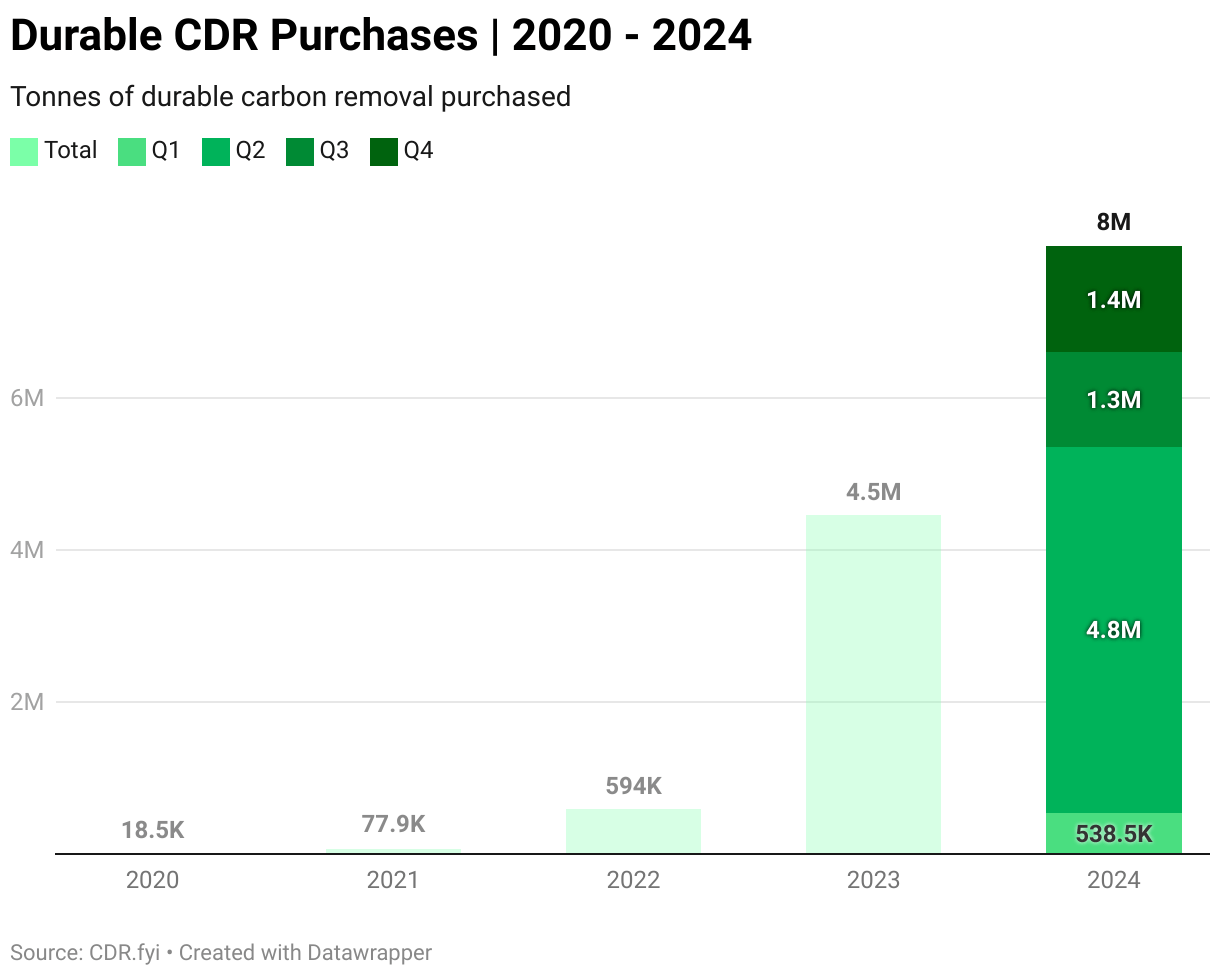
3. Public Sentiment Continues to Center on Technology-Driven Approaches to Fight Climate Change
As public targets and Nationally Determined Contributions (NDCs) consistently fall short, and the news becomes increasingly direr with depictions of an already changing climate, many sectors of the public, such as environmental organizations, research institutions, and government agencies, have vocally rallied around CDR as the primary tool to turn back the clock on this issue. Whether emerging from hope or nihilism, this suite of technologies has garnered broad public acceptance. Carbon crediting remains somewhat controversial, but innovative CDR technologies like direct air capture with carbon storage (DACCS), BECCS, and biomass carbon removal and storage (BiCRS) are an ever-popular panacea.
4. Nature-Based Carbon Removals to Fill the Gap
Among the many methods for achieving carbon removal, the relative affordability and near-term scalability of nature-based solutions are driving significant investment and ongoing credit retirement. Afforestation, reforestation, and revegetation (ARR), along with projects that capture and store CO2 in coastal and ocean ecosystems (e.g., blue carbon), have become a viable option for buyers seeking large credit volumes in the near term. The notion of shorter-duration permanence has been largely overshadowed by the numerous co-benefits of tree planting and revegetation. Large offtake deals were signed in 2024 in this category with both industrial and technology companies, indicating broad-based interest. Examples include Microsoft’s commitment to buy 8 million metric tonnes of nature-based removal credits from BTG Pactual Timberland Investment Group (TIG) through 2043. Other, somewhat smaller, deals included French multinational electric utility Engie SA pre-purchasing 5 million metric tonnes of nature-based removal credits over the 2030-2039 period from Catona Climate, a carbon credit intermediary, and Microsoft’s commitment to buy 1.6 million metric tonnes of removal credits over 30 years from a reforestation project in Panama. Some companies have looked to nature-based removals as an alternative to Reducing Emissions from Deforestation and Forest Degradation (REDD+) and Improved Forest Management (IFM) avoidance credits while maintaining a few direct community and ecosystem benefits inherent to such projects. As CDR technology advances, forests and ecosystems continue to fill in for deliveries from technological solutions.
5. CDR Project Developers Have More Options to Market
Project developers in enhanced rock weathering (ERW), biochar, and BECCS have been exploring non-credit markets as a means to support growth and stabilize revenues. Projects interacting directly with global food and product supply chains have found some receptivity for insetting their removal or avoidance projects within the consumer goods and renewable fuel industries. Carbon insetting empowers companies to actively reduce their Scope 3 emissions by funding emissions reduction initiatives directly within their value chain. This means companies aren’t waiting for suppliers to act; instead, they’re directly facilitating emission reductions by financing projects that enable their suppliers to avoid, reduce, or sequester greenhouse gas (GHG) emissions. Though still a largely bilateral and ad-hoc market, this is a space to watch as Scope 3 emission reporting moves from an academic exercise to direct and impactful climate action. Whether or not the Science Based Targets initiative (SBTi) allows the use of carbon removal credits for near-term corporate GHG reduction goals or long-term net-zero targets aligned with the Paris Agreement, CDR projects designed for climate targets are finding new, alternative pathways to market. Combined with impending access to compliance markets in the EU and elsewhere, these new markets for carbon removals are slowly reducing the demand constraint on CDR, limiting industry growth and investment opportunities.
6. Measurement, Reporting, and Verification (MRV) Will Take Center Stage
In contrast to 2022 and earlier, when a handful of well-funded CDR companies could secure offtake agreements based on generic claims derived primarily from lab studies and theory, developers are now being held to a higher standard. Projects transacting bilaterally based on weak protocols have given way to rigorous quantification and traceability facilitated by expanding written methodologies and crediting registries to parallel the breadth of emerging CDR approaches. At last count, more than 45 CDR-specific methodologies were listed on carbon registries or used by proprietary developers. This represents at least 10 times the number available at the end of 2022 and illustrates this sector’s ever-critical nature of diligent MRV. This number will continue to grow as the market strives for greater precision and specificity in measuring the impact of a greater variety of CDR project types.
In summary, the CDR sector is poised for significant growth in 2025, driven by increased investment in provable approaches, supportive policies, and public sentiment favoring technology-driven solutions. Nature-based removals are expected to dominate due to their affordability and scalability while project developers explore new markets to stabilize revenues. MRV will become increasingly important to ensure the credibility of CDR projects. As the CDR industry evolves, stakeholders must stay informed and adaptable to capitalize on emerging opportunities.
About EcoEngineers
EcoEngineers is a consulting, auditing, and advisory firm with an exclusive focus on energy transition and decarbonization. From innovation to impact, EcoEngineers helps its clients navigate the disruption caused by carbon emissions and climate change. Its team of engineers, scientists, auditors, consultants, and researchers live and work at the intersection of low-carbon fuel policy, innovative technologies, and the carbon marketplace. For more information, visit www.ecoengineers.us.
About the Author
David LaGreca is the Managing Director of Carbon Markets at EcoEngineers, with experience in all major GHG programs across the Americas. Mr. LaGreca has brought projects through every phase, from conception through financing, methodology development, project registration, and verification. He has worked on hundreds of diverse projects, including reforestation, energy, methane abatement, blue carbon, and novel carbon removal technologies. He has developed and audited GHG inventories for communities, companies, and governments. Mr. LaGreca works to strategically align projects with markets to make decarbonization a viable business.
For more information about how EcoEngineers can help you navigate the CDR sector and set your business or organization up for success in 2025 and beyond, contact:
David LaGreca, Managing Director, Carbon Markets | dlagreca@ecoengineers.us