

This article was originally published by Lisa Hanke on LinkedIn on April 9, 2026.
The U.S. Environmental Protection Agency (USEPA) released the Final Rule for Renewable Fuel Standard (RFS) Set Rule 2 on March 27, 2026. The rule establishes volume requirements for 2026 and 2027 and introduces several programmatic, compliance, and technical updates that are expected to impact renewable fuel producers, obligated parties, and verification activities. Below are the total applicable volumes, measured in billion RINs (renewable identification numbers).
Total Applicable Volumes for 2026 and 2027 (billion RINs)
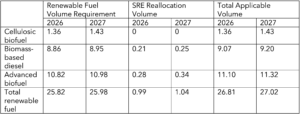
The USEPA set Renewable Volume Obligations (RVOs) for two years (2026–2027) rather than three, citing increased uncertainty in projecting further out and a desire to avoid later revisions. Because the final rule was issued after the start of 2026, the agency characterizes the 2026 standards as partially retroactive but indicates obligated parties can still meet the standards in the market.
The implied conventional biofuel volume remains 15 billion gallons per year. The USEPA acknowledged supply may fall short but expects the gap can be met with additional volumes of advanced biofuel. The USEPA’s growth assumptions are driven primarily by soybean oil, with smaller increases from used cooking oil and animal fats, and the agency projects renewable CNG/LNG growth may be constrained by vehicle availability rather than fuel supply.
Small Refinery Exemptions (SREs) are annual waivers granted by the USEPA to small petroleum refineries (under 75,000 barrels per day) that demonstrate “disproportionate economic hardship” in complying with regulation’s blending requirements. In the rule, the USEPA finalized a 70% partial reallocation of exempted RVOs from 2023–2025 into the 2026–2027 compliance years. It cites its 2025 SRE decisions (including a large set of decisions issued in August 2025 and additional decisions in November 2025) as creating potential market impacts. The partial reallocation is intended to mitigate negative demand impacts in 2026–2027 while recognizing the role of carryover RINs in maintaining RIN market liquidity.
Cellulosic Waiver Credits (CWCs) are a mechanism that allows obligated parties (refiners/importers) to comply with cellulosic biofuel mandates when the market fails to produce enough physical biofuel. In the rule, the USEPA waived the 2025 cellulosic biofuel requirement, triggering availability of CWCs priced at $1.91 for compliance flexibility.
Ethanol from corn kernel fiber is classified as crop residue and eligible for cellulosic ethanol. In the new rule, the USEPA assumes 90% facility adoption with a 1% conversion rate, declining to adopt higher claimed rates due to insufficient data.
In the RFS, equivalence values are numerical factors assigned by the USEPA to determine how many RIN credits are generated per physical gallon of renewable fuel, based on energy content relative to ethanol. In this rule the USEPA addressed the following (effective 2027):
- The USEPA opted not to change Renewable diesel and renewable jet fuel equivalence values set at 1.5.
- Renewable naphtha equivalence value was set at 1.4.
- The implemented changes to correct prior over-crediting of fossil-derived hydrogen content.
The USEPA also specified where RINs must be generated for most renewable fuels:
- Domestic producers at the point of production or point of sale
- Foreign RIN-generating producers at the point of production or when the fuel is loaded for transport to the covered location
- Importers upon importation into the covered location
For renewable natural gas (RNG) and fuels that are gaseous at standard temperature and pressure (e.g., renewable CNG/LNG), RINs must be generated no later than five business days after all applicable RIN generation requirements are met, with added clarification of EMTS submission timing. The rule includes an illustrative monthly RNG example tying the “fuel production date” to the end of the production month once the final required pipeline statement is received.
Biogas Regulatory Reform Rule
The Biogas Regulatory Reform Rule (BRRR) is a set of regulations finalized by the USEPA in 2023. It streamlines how biogas-to-RNG projects are registered, measured, and reported to generate RINs. Below are some changes that were implemented by the recent Set Rule.
- Engineering reviews and sampling frequency reduced to once every three years starting in 2027.
- RNG producers now need to submit a Certificate of Analysis (CoA) once every three years rather than annually.
- Registration requirements simplified by removing certain meter justification requirements.
- Eliminates several quarterly reporting requirements, including certain end-of-quarter renewable fuel/RIN ownership calculations and specific quarterly reporting elements for biogas transportation fuel energy and sales location.
- Adds a RIN generation reason code beginning January 1, 2027.
- Engineering review site visits must be conducted within six months prior to submitting a registration request, and the USEPA added additional approved measurement protocols (e.g., AGA/ASME/ISO methods and additional ASTM methods for gas constituents) to support biogas/RNG measurement and testing.
- Third-party auditors must renew registration every two years.
- Updates were made to Table 1 pathways without invalidating existing registrations.
- Adds new biointermediates including activated sludge and converted oils.
In addition to these changes, the USEPA redefined some of its entities within the BRRR. They are as follows:
- Renewable fuel producer is defined as “any person that owns, leases, operates, controls, or supervises a facility where renewable fuels are produced.”
- Renewable fuel oil is defined as “heating oil that is renewable fuel and that meets paragraph (2) of the definition of heating oil,”
- Renewable naphtha is defined as “naphtha that is renewable fuel,”
- Renewable jet fuel is defined as “jet fuel that is renewable fuel and that meets ASTM D1655 or ASTM D7566.”
- Foreign renewable fuel producer is defined as “any person that owns, leases, operates, controls, or supervises a facility outside the covered location where renewable fuel is produced.”
- Importer was previously defined as “any person who imports transportation fuel or renewable fuel into the covered location from an area outside of the covered location, the importer of record or an authorized agent acting on their behalf, as well as the actual owner, the consignee, or the transferee, if the right to withdraw merchandise from a bonded warehouse has been transferred.”
Overall, the Set Rule provides additional compliance flexibility, clarifies longstanding implementation issues, and adjusts crediting methodologies. While generally viewed positively by industry, the changes will require careful review of registration, reporting, and auditing practices beginning in 2026 and 2027.
Our team is ready to assist you with working through your questions and issues to successfully comply with these updates to the RFS. If you haven’t already, the time to start is now, and EcoEngineers can be your guide through this transition period. Please reach out to us with any questions or issues at clientservices@ecoengineers.us