

This article was originally published by Petroleum Technology Quarterly in its Q4 2026 edition.
Embedding compliance to unlock carbon credit value for the alcohol-to-jet pathway
Kristine Klavers, Managing Director, Houston and Low-Carbon Petroleum , EcoEngineers
Every week, investors and project developers ask the same question: “We’re ready, when do we get our credit value?” The answer is almost always more complicated than they expect.
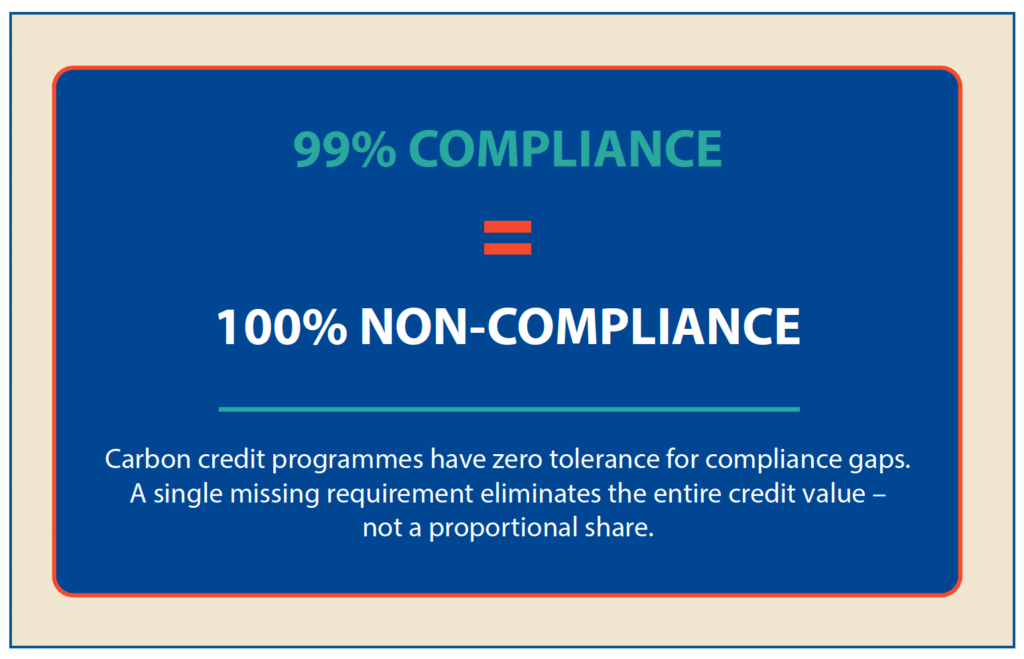
Unlocking the full economic value of a biomass-to-sustainable aviation fuel (SAF) investment is not simply a matter of building a plant and switching it on. It requires regulatory compliance to be built in from day one, a clear understanding of how each credit programme works, and an acceptance that 99% compliance is, in practice, 100% non-compliance.
This article covers the alcohol-to-jet (ATJ) pathway, one of the most commercially active routes from biomass to SAF. It maps the compliance and credit landscape across US federal programmes, the California Low Carbon Fuel Standard (CA-LCFS), European requirements, and the Carbon Offsetting and Reduction Scheme for International Aviation (CORSIA). The aim is to show investors how to de-risk a project and maximise return on investment (ROI) by treating compliance as a core project development and commercial discipline, not a late-stage administrative task.
De-risking the low-carbon investment
The standard checklist for de-risking a new fuel plant covers market, technology, feedstock, logistics, and offtake. Those five boxes are necessary, but they only get you to the wholesale price of the litre. When the business case depends on carbon credits, there are six additional disciplines to address:
- Measure your carbon intensity (CI) score at the design stage. This is the number investors will scrutinise and the basis on which programme-dependent credits are calculated.
- Recognise that regulations are jurisdictional. The US Renewable Fuel Standard (RFS), 45Z federal tax credit, CA-LCFS, EU Renewable Energy Directive III (RED III), and CORSIA all use different measurement methodologies, have different eligibility rules, and run on different timelines.
- Confirm eligibility of your feedstock and process for each programme you intend to access.
- Establish traceability from feedstock origin through to finished fuel delivery. Verifiers will require it.
- Account for timing. Credit programmes have petition processes, operational milestones, and verification cycles that can take years.
- Verify. Independent third-party verification is mandatory across every major credit programme.
One case study shows what happens when this goes wrong. One operator converted an existing refinery to renewable fuels production and invested heavily in compliance, with California LCFS carbon credits at the centre of its business case. The facility was generating credits under a feedstock-to-finished-fuel temporary pathway while it waited for a site-specific provisional pathway to be certified.
Generally, the CI scores for temporary pathways generate fewer credits than a site-specific CI score, causing a shortfall in actual revenue versus projected revenue. The company ran into serious financial difficulties, bankruptcy, and a formal restructuring of the company, returning the facility to conventional hydrocarbon production.
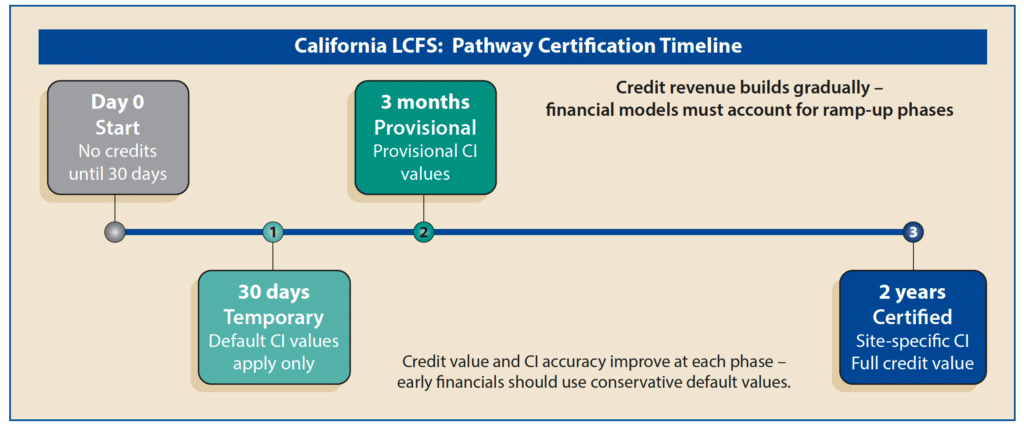
The lesson is clear: if the financial model depends on credit revenue, the timeline for receiving that revenue must be in the project plan from the start. (See Figure 1.)
ATJ pathway and ASTM approval
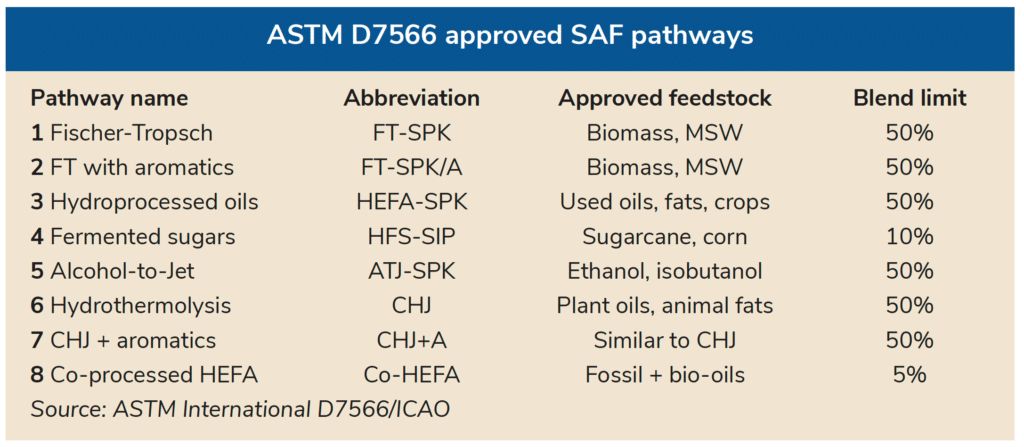
Before any carbon credit can be sold through offtake agreements, the fuel must meet ASTM International specifications. ASTM D7566 governs SAF and currently recognises eight production pathways, including Fischer-Tropsch, hydroprocessed esters and fatty acids, fermented sugars, and alcohol-to-jet.
ATJ, which converts ethanol or isobutanol into jet fuel, carries a 50% blend limit, considerably more favourable than co-processed HEFA, which is capped at 5%.
Obtaining ASTM approval for a new pathway is a lengthy, safety-driven process that can take years. For investors coming to market now, working within the already-approved pathways is the most practical approach. (See Table 1)
US federal credits: RFS and the biointermediate challenge
The RFS assigns Renewable Identification Numbers (RINs) based on Table 1 in the programme, which sets out eligible feedstock-process combinations and their D-code. The D-code determines RIN value.
For ATJ, there is a critical gap: no default ATJ pathway appears in the programme’s Table 1. A producer wanting to generate RINs from ATJ-produced SAF must first petition the US Environmental Protection Agency for a pathway determination, a process that typically takes well over a year.
The only currently approved commercial examples are LanzaJet’s facility in Georgia and Summit Next Gen’s facility in Texas. These approvals cover ethanol sourced from a specific plant in Brazil, shipped in a specific way, and processed at that specific US site. They cannot be applied to other producers, other supply chains, or other feedstock origins. Each new producer needs a separate petition.
There is a further complication from the two-step nature of ATJ production. Ethanol is produced first, then converted to jet fuel. Since the products are processed at different locations and can technically enter the transportation fuel market independently, the EPA classifies the ethanol as a biointermediate under the RFS. (See Figure 2)
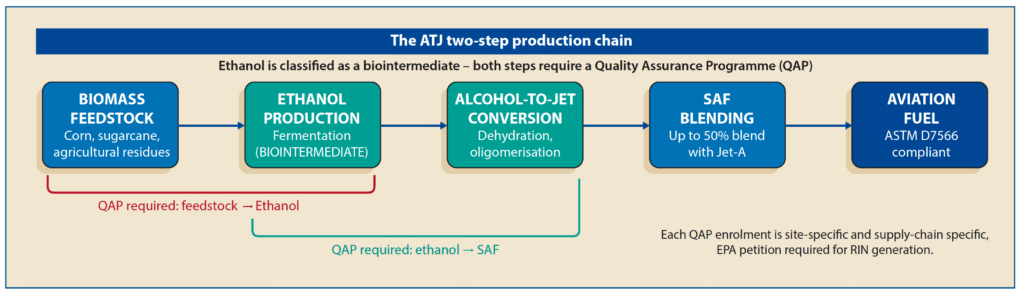
The use of biointermediates requires a Quality Assurance Programme (QAP); both the ethanol producer and the jet fuel producer must be enrolled in a QAP. This adds complexity and time, though it can also create additional client opportunities for QAP providers with a broad supply-chain footprint.
A detail that catches many producers off guard is the same-supplier requirement within the QAP framework. The organisation providing QAP verification for the biointermediate producer and the SAF facility must be the same accredited body. A producer cannot use one QAP provider for ethanol verification and a different one for the SAF stage.
Selecting a QAP provider with full supply-chain coverage is therefore a decision that needs to be made before the first petition is filed, not after the plant is running.
45Z clean fuel production credit
The US Inflation Reduction Act introduced the 45Z Clean Fuel Production Credit, with up to $1.00 per gallon for SAF meeting qualifying CI thresholds. Eligible ATJ feedstocks include US corn starch, US sorghum grain, Brazilian sugarcane, and US corn stover. Other feedstocks can apply, but this requires a lengthier Provisional Emissions Rate application.
The prescribed lifecycle analysis model is the 45ZCF-GREET model or, alternatively, the CORSIA emissions model. This is a different framework from those used in California or Europe and has practical implications for CI-scoring strategy.
A key constraint is the no-stacking rule. A producer cannot claim 45Z credits for the ethanol-production step and then claim them again for the SAF-conversion step on the same feedstock. Where ethanol is purchased from a third-party producer that is also claiming credits on that ethanol, the SAF producer captures the 45Z value, and the ethanol producer may negotiate a small fraction of the contract. This must be resolved contractually before project economics can be finalised.
One further advantage of the 45Z framework for producers using agricultural feedstocks is that the current model does not explicitly include indirect land-use change penalties. This contrasts with the US LCFS and CORSIA frameworks, in which indirect land-use change factors can materially affect the CI score for crop-based feedstocks.
As a result, the same production pathway may achieve more favourable CI outcomes under 45Z than under other programmes. These methodological differences reflect distinct policy objectives but have direct implications for project economics. For producers using feedstocks such as US corn starch or sorghum grain, indirect land-use change treatment can influence programme attractiveness and the order in which credits are pursued.
California LCFS: Timing is everything
The California LCFS, administered by the California Air Resources Board, is the most developed state-level credit programme in the US and can generate significant credit value per tonne of carbon dioxide equivalent avoided. (See Figure 3.) However, the application process is primarily post-commissioning:
- Temporary pathway: Available after 30 days of operations.
- Provisional pathway: Available after three months of operations.
- Full certification: Available after two years of steady-state operations.
During the temporary and provisional phases, producers must use default CI values rather than site-specific ones. Default values are less favourable, so financial models built on full-certification CI numbers from day one of production will overstate early revenues.
The previous case, where the operator converted an existing refinery to renewable fuels production, is a direct example of what happens when this timing gap is not properly accounted for.
The 2024 LCFS revision also introduced financial penalties for producers whose actual CI score deviates from their certified pathway value. Start-up problems, feedstock variability, and process upsets all carry a direct financial cost under the revised rules. Investors should budget for this risk.
RED III and the 65% reduction threshold
SAF is a global commodity, and European airlines are mandated buyers under the ReFuelEU Aviation regulation. Qualifying for European credits requires meeting tighter CI-reduction thresholds than US programmes.
Under RED III, existing production facilities must demonstrate at least 65% lifecycle greenhouse gas savings against the fossil comparator. The calculation methodology is different from GREET-based US models, and verification is conducted by International Sustainability and Carbon Certification or the Roundtable on Sustainable Biomaterials rather than through a QAP.
Crop-based feedstocks are not allowed under the ReFuelEU Aviation regulation. Producers targeting both US and European markets will need to manage parallel compliance frameworks. The same production process can generate different CI results depending on which model is applied, which has practical consequences for market-access planning.
CORSIA: The global baseline
CORSIA, operated by the International Civil Aviation Organization, provides a global framework for airlines to offset international carbon dioxide emissions, with CORSIA-eligible SAF as one of the compliance mechanisms.
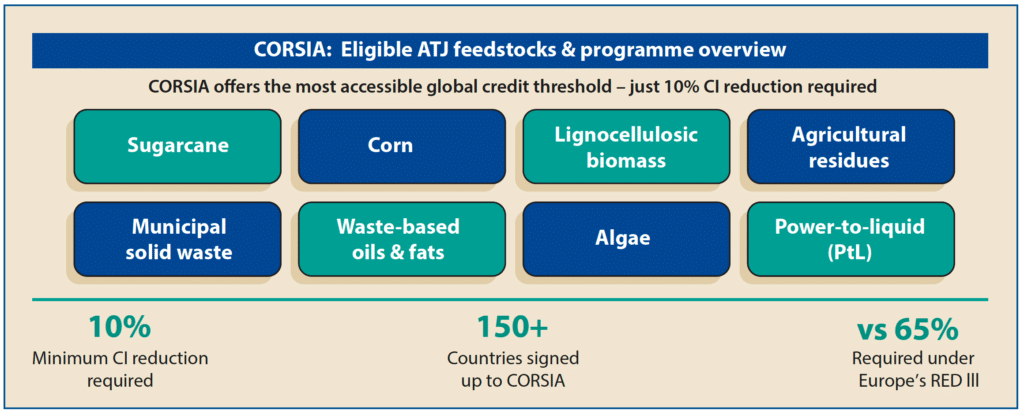
CORSIA accepts a wide range of ATJ feedstocks, including sugarcane, corn, lignocellulosic biomass, agricultural residues, municipal solid waste, waste-based oils, algae, and power-to-liquid pathways. With more than 150 countries signed up, the programme offers SAF producers a broad addressable market. (See Figure 4.)
The minimum CI reduction required under CORSIA is just 10% against the fossil baseline. That is considerably lower than US RFS requirements, the 65% required in Europe, or the thresholds typically required under CA-LCFS. For producers whose CI score is too high to qualify for premium credit programmes, CORSIA is a practical entry point to global credit markets.
US credit stack
To put the credit stack in practical terms, based on current market rates, a fully compliant ATJ-SAF producer accessing all available US programmes can expect to layer the following on top of the wholesale fuel price:
- RFS D4 RINs have recently traded at around $1.50 per RIN.
- The 45Z credit adds up to $1.00 per gallon for qualifying SAF.
- The California LCFS, once full certification is achieved, has been generating approximately $62.50 per metric tonne of carbon dioxide equivalent avoided.
For a plant producing 30 million gallons of ATJ-SAF per year and fully enrolled in all three programmes, combined credit revenue can comfortably exceed the commodity fuel margin. The wholesale SAF price is the floor of the revenue model, not the ceiling, provided compliance is embedded from the outset.
The inverse is equally important to understand. A producer who misses a single QAP-enrolment deadline, whose actual CI score deviates from the certified pathway value, or who fails a verification audit does not lose a proportional share of credit revenue. Under every programme described in this article, non-compliance is binary: the credits are not issued.
This is why compliance milestones belong in the project schedule as hard engineering deliverables, given the same weight as commissioning dates and offtake agreements.
Market dynamics: Offtake structure and pricing
Credit value is only one part of SAF project economics. Offtake-agreement structure matters a great deal.
Around 75% of current SAF and renewable-diesel offtake agreements are structured as fossil-fuel-plus agreements, meaning the SAF price moves with the jet-fuel market rather than tracking the cost of production. When fossil-fuel prices rise, these agreements make renewable fuel more expensive for airlines, and a number of airlines are now pushing back on agreements structured this way.
Cost-of-production agreements, where the SAF price is indexed to feedstock and operating costs, give producers more stable economics. However, they represent only about one in four deals today.
As fossil-fuel price volatility continues and airline compliance mandates grow, there are signs this balance is shifting. Investors coming to market now have an opportunity to negotiate cost-of-production terms before demand significantly outpaces supply.
The broader energy-price environment is also providing momentum. Rising fossil-fuel costs strengthen the economic case for renewables, and there is growing political pressure in many markets to reduce reliance on imported hydrocarbons. Australia’s recent public discussion about its level of renewable exports while domestic fuel costs remain high is one illustration of a shift in sentiment that is relevant to SAF investment globally.
Embed compliance, increase ROI safeguard
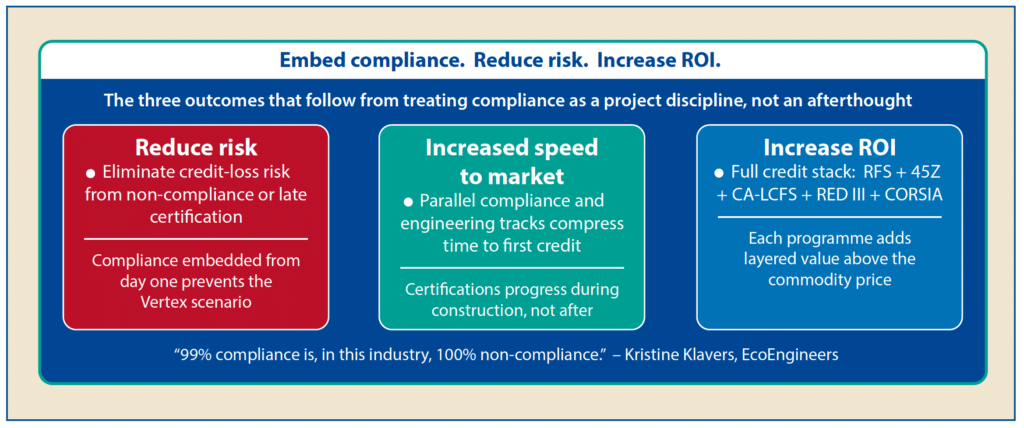
The investment case for biomass-to-SAF via the ATJ pathway is strong, provided investors understand the full compliance journey. (See Figure 5.) Demand is there, regulatory mandates are growing globally, ATJ is ASTM-approved, feedstock options are available, and airlines are ready to buy.
What investors consistently underestimate is the time, process rigour, and sequencing needed to unlock each layer of credit value on top of the commodity price. The key principles are straightforward, even when execution is not:
- Calculate your CI score from the design phase and revisit it at every stage gate.
- Treat each credit programme, including RFS, 45Z, CA-LCFS, RED III, and CORSIA, as a separate regulatory engagement with its own eligibility criteria, lifecycle-assessment model, verification standard, and timeline.
- Build the credit timeline into the financial model. Do not assume day-one credit revenue.
- Address biointermediate and QAP requirements early if your ATJ process involves ethanol as an intermediate product.
- Resolve credit-stacking implications with feedstock suppliers at the term-sheet stage.
Coming back to where the discussion started: 99% compliance is, in this industry, 100% non-compliance. The difference between a profitable low-carbon investment and one that fails while waiting for credits to materialise almost always comes down to whether compliance was built in from day one.
Investors who treat it as an afterthought will find that the credits they counted on arrive late, are lower in value than projected, or, in the worst cases, do not arrive at all.

Kristine Klavers is Managing Director, Global Low-Carbon Petroleum & Refining, renewable diesel and SAF, at EcoEngineers, an LRQA company. She is based in Houston and directs renewable-energy consulting and auditing at the energy-transition advisory firm.
More EcoInsights

27 October 2026
Carbon Counts: What Can Carbon Markets Learn from Each Other?

22 October 2026
EcoEngineers Names Brad Pleima Chief Executive Officer

7 October 2026
