

By Roxby Hartley, Ph.D., climate risk director, and Chelsa Oren, director, biodiesel and ethanol services, EcoEngineers, An LRQA Company
While much of the industry’s attention remains focused on evolving tax credits and carbon intensity (CI) reduction strategies, another change is quietly taking shape. This change has the potential to fundamentally alter how feedstocks are sourced, documented and verified.
Emerging discussions around feedstock traceability, particularly within California’s Low Carbon Fuel Standard (LCFS) framework, suggest that producers may soon be required to demonstrate a much higher level of transparency in their supply chains. Although final requirements are still being defined, the direction is clear. The ability to trace feedstocks back to their origin is becoming increasingly important. For biofuel producers, this is not just a compliance issue. It is a supply chain and business risk that warrants attention now.
From Commodity to Traceable Input
Historically, feedstocks such as corn, soy and other agricultural commodities have been treated as interchangeable inputs within a largely opaque supply chain. Producers often rely on aggregators, elevators and crushers, with limited visibility into the exact origin of the material.
That model is beginning to shift. Future requirements are expected to center around three core elements:
- Field-level traceability, including geospatial data such as coordinates or shapefiles
- Farmer attestations confirming origin and production practices
- Auditable documentation maintained across the supply chain
While the exact structure of these requirements remains uncertain, comparable systems already exist and provide a useful reference point.
What Existing Programs Can Tell Us
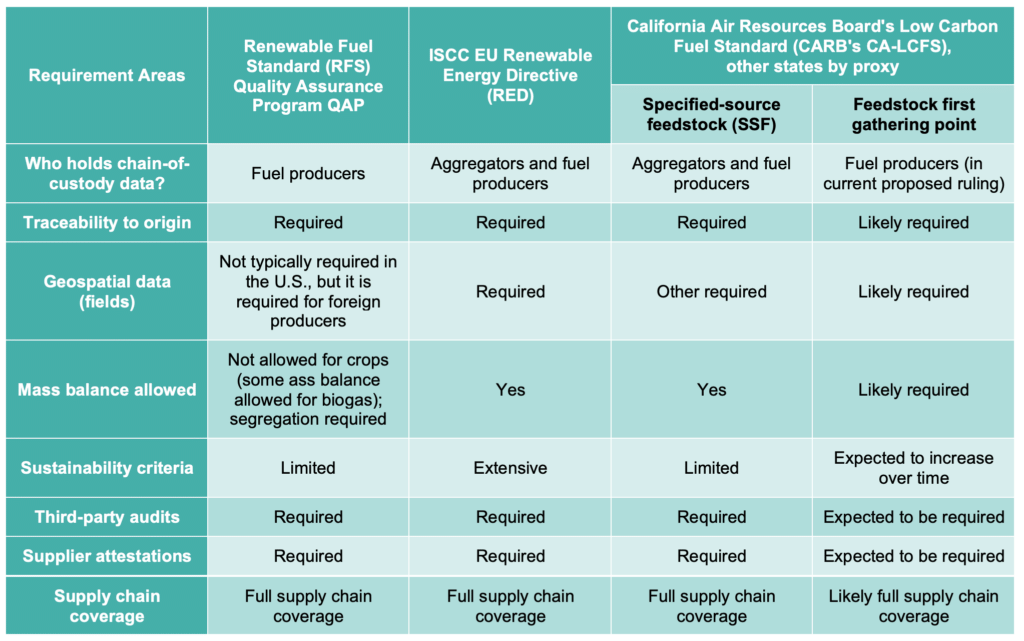
To understand where feedstock traceability may be heading, it is helpful to look at current programs already in place across global and U.S. markets. The California Air Resources Board (CARB) designation of Specified Source Feedstocks (SSFs) programs require traceability back to a defined origin, supported by detailed documentation and verification.
The EU Renewable Energy Directive (EU RED) sustainability requirements, as enforced through certification bodies such as the International Sustainability and Carbon Certification (ISCC), provide a widely recognized framework that combines traceability with sustainability criteria, often using a mass balance approach. The U.S. Renewable Fuel Standard (RFS) emphasizes verification and auditability for foreign feedstocks, making the use of the Quality Assurance Program (QAP) an effective mechanism for both foreign producers and obligated parties in the U.S. to ensure compliance with the RFS rules. The QAP requirements, being voluntary, do not affect domestic biofuel producers unless they use biointermediate feedstocks.
A fourth reference point emerged just as this shift was taking shape. In June 2026, USDA finalized its Technical Guidelines for the Production of Regenerative Agricultural Biofuel Feedstocks, a voluntary federal framework for quantifying, reporting and verifying the carbon intensity of corn, soybeans, sorghum and spring canola. The rule includes its own chain-of-custody standards, farmer attestations and third-party verification requirements, built around a mass balance approach rather than book-andclaim accounting. It is worth noting that, as a separate program, it is not required under LCFS, and CARB is under no obligation to adopt it.
USDA has described the guidelines as intended to inform the subsequent development of requirements for other programs that incentivize low-carbon biofuels, and much of the early industry reaction has centered on its relevance to the federal 45Z tax credit rather than LCFS. Still, for producers already thinking about traceability infrastructure, it is a fourth model worth watching alongside CARB’s SSF program, EU RED/ISCC and the RFS QAP.
Based on early signals, future requirements may resemble a hybrid of these systems. In many discussions, the approach has been described as similar to a lighter version of ISCC, with an initial focus on traceability and the potential for expanded sustainability requirements over time.
How Current Frameworks Compare
The technical requirements are only part of the equation. The more significant challenge lies upstream in the supply chain. Feedstock traceability depends on participation from farmers, elevators, aggregators and crushers. Many of these stakeholders are not currently structured to provide detailed origin data. In commodity markets, feedstocks are often blended, traded and resold without a clear linkage to a specific source.
This creates a fundamental tension. Producers may ultimately be responsible for demonstrating traceability, but they do not fully control the upstream data needed to do so.
Why Contracts Will Need to Change
As expectations evolve, contractual relationships will need to evolve alongside them. Producers will likely need to require greater transparency from suppliers, including access, and in some cases direct access, to documentation and the ability to support third-party audits. Contracts may also need to address liability if the required data cannot be provided.
Experience from existing regulated markets shows that gaps in documentation can lead to significant consequences. Entire volumes of fuel have been deemed ineligible when traceability could not be demonstrated, resulting in lost credits and financial exposure. This underscores that traceability is not simply an administrative requirement. It is a commercial and contractual issue that can directly affect project economics.
Risk exposure goes beyond compliance. Programs such as the LCFS carry real financial consequences when requirements are not met. If feedstocks cannot be verified, fuel pathways may be invalidated, and associated credits may be revoked. In some cases, volumes may be treated as conventional fuel, increasing compliance obligations and eroding value. The risk is therefore not theoretical. Insufficient traceability can directly impact margins and long-term market access.
A Different Starting Point for Ethanol
Producers of biodiesel and renewable diesel are generally more familiar with traceability requirements, having already navigated programs that require detailed supply chain verification because of their use of used cooking oil. For ethanol producers, this represents a more significant transition.
Facilities that have historically relied on broad commodity sourcing strategies may need to rethink supplier relationships, data collection processes and internal compliance systems. This shift will require coordination across the supply chain and a willingness to engage partners that may not yet be prepared for this level of scrutiny. EcoEngineers has a long experience of helping the SSF feedstock providers and users navigate the regime CARB imposed.
What Producers Should Do Now
Even with uncertainty around final requirements, there are practical steps producers can begin taking today:
- Start conversations with suppliers to assess awareness and willingness to provide traceability data
- Evaluate current visibility into feedstock origin and identify gaps
- Review contracts to ensure they allow for data sharing and audit access
- Monitor regulatory developments and emerging guidance
- Learn from biodiesel and renewable diesel markets that have already navigated similar requirements
Feedstock traceability is not yet fully defined, but it is clearly moving from concept to reality. As regulatory expectations continue to develop, producers that take early steps to engage their supply chains will be better positioned to adapt. In a market where compliance, carbon intensity and credibility are increasingly interconnected, the ability to demonstrate where feedstocks come from and how they are produced will become a defining factor. The time to begin preparing is now.
More EcoInsights

7 October 2026
Monetizing Biomass-to-SAF Investments

1 October 2026
