

Europe’s Maritime Regulations Carry Penalties, So Understanding Their Interplay Increases Compliance Value Beyond Just Fuel Prices
By Urszula Szalkowska, managing director, European Markets, EcoEngineers, and Dáša Mamrillová, government affairs director, European Waste-based & Advanced Biofuels Association (EWABA)
Europe’s maritime sector is in the middle of its most significant regulatory transformation in decades. The extension of the European Union Emissions Trading System (EU ETS) to shipping, the arrival of FuelEU Maritime, the renewable fuel provisions of the Renewable Energy Directive (RED III), and the infrastructure mandates of the Alternative Fuels Infrastructure Regulation (AFIR) are no longer abstract compliance obligations. Together, they are becoming the primary forces determining which fuels qualify for use, how emissions are priced, which technologies gain an edge, and where capital flows next.
Three questions cut to the heart of the matter:
- What makes a marine fuel valuable under EU rules?
- How do the regulations generate demand and pricing signals?
- Which fuels are positioned to win in different market segments?
The answers indicate that bunkering decisions are equally based on compliance and cost, with compliance dictating cost.
Two Regulatory Levers, One Objective
At the highest level, the EU framework pursues maritime decarbonization through two complementary mechanisms. The first reduces emissions at the vessel and sector level through the EU ETS and its associated monitoring, reporting, and verification (MRV) rules. The second increases the supply of low-carbon fuels and the infrastructure to deliver them, through FuelEU Maritime, RED III, the rules governing renewable fuels of non-biological origin (RFNBOs) and recycled carbon fuels (RCFs), and AFIR.
Under the EU ETS, shipping companies must surrender allowances for their reported greenhouse gas (GHG) emissions on voyages within the European Economic Area, at berth in EU ports, and for half of the emissions on voyages to or from third countries. The obligation has scaled up quickly: in 2025, 70% of emissions required allowance surrender, and starting in 2026, the requirement reaches full coverage. Sustainable biofuels that meet RED III sustainability standards can be reported with a zero-emission factor, thereby lowering the number of allowances a vessel operator needs to purchase.
FuelEU Maritime operates differently. Instead of pricing carbon, it enforces increasingly strict limits on the life cycle (well-to-wake) GHG emissions of onboard energy, compared to a baseline of 91.16 grams of CO2 per megajoule. The required reduction climbs from 2% in 2025 to 6% in 2030, 31% in 2040 and 80% by 2050. The target must be met with fuel, which means the regulation creates direct demand for compliant fuels.
Where the Penalties Create the Price
The economic stakes behind these mechanisms are concrete. Under EU ETS, failing to surrender allowances triggers an excess emissions penalty of at least €100 per tonne of carbon dioxide equivalent (CO2e), on top of the allowance price itself, which has recently traded between €70 and €80 per tonne. Under FuelEU Maritime, exceeding the permitted GHG intensity generates a compliance deficit penalty pegged to the price of very low sulfur fuel oil, fixed at €2,400 per tonne, with a multiplier for repeat non-compliance. Persistent failure under either regime can ultimately result in detention, expulsion orders, or refusal of port access. Layer RED III’s sustainability and counting rules on top, and a single compliant molecule of fuel can generate value across all three frameworks simultaneously. As shown in Figure 1, regulatory attributes have become a core driver of fuel pricing in the bunker market, alongside energy content.
Figure 1. One Fuel, Three Frameworks
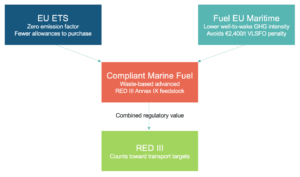
A compliant waste-based marine fuel can simultaneously reduce EU ETS allowance purchases, satisfy FuelEU Maritime’s well-to-wake GHG intensity limit, and count toward RED III transport targets, generating compliance value across all three programs in a single bunkering transaction.
Source: EcoEngineers / EWABA
Biodiesel Leads a Narrow Field
In practice, the market has already picked a near-term winner. Biodiesel accounted for roughly 70% of fuel used for FuelEU Maritime compliance in its first year, largely blended into conventional fuel oil at 20–30% volumes using existing infrastructure and engines. Liquefied Natural Gas (LNG) was the second-most-used compliance fuel, though it is mainly supported by dual-fuel engines and careful accounting to ensure the bio-LNG share actually delivers the claimed emissions savings, if used.
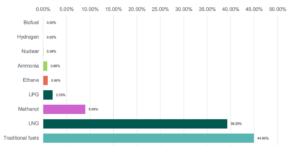
Fleet data underscore how early this transition still is: only about 9% of global fleet tonnage currently operates on alternative fuels, even as more than half of tonnage on order is alternative-fuel capable. As shown in Figure 2, methanol bunkering is gaining ground, particularly in Rotterdam, and now represents roughly 10% of tonnage on order. Hydrogen and ammonia remain future options, promising on paper but constrained by bunkering safety standards, infrastructure, and cost, with the first commercial ammonia bunkering still roughly two years out.
Figure 2. The New-built Fleet is Betting on LNG and Methanol
Source: LRQA
Not all biofuels qualify equally. First-generation, food- and feed-crop-based biofuels carry the same emission factor as fossil fuel equivalents under FuelEU Maritime, eliminating any incentive to bunker them, even though they remain allowed with limitations under RED III’s broader transport targets, capped at 7%. That leaves waste-based and advanced biofuels under RED III’s Annex IX (used cooking oil, animal fats, and other Annex IX-A and IX-B feedstocks) as the only category currently capable of satisfying all three EU programs at once.
Loopholes, Anti-Dumping Duties, and a Push for Parity
The framework has rough edges. Flexibility provisions that let shipowners pool compliance across vessels, combined with a preferential accounting method for blended biofuels and the EU’s anti-dumping duties on Chinese biodiesel, have shifted bunkering volumes toward Singapore and away from Rotterdam, Europe’s traditional bunkering hub. Biodiesel bunkered in Singapore is not subject to the same anti-dumping duties, even amid suspicion of fraudulent Chinese import certification, making it meaningfully cheaper to bunker there and trade the resulting over-compliance to other vessels.
This dynamic undermines European producers and raises sustainability questions about fuel bunkered outside the EU. EWABA’s ask of policymakers is straightforward: a level playing field, ideally achieved if the International Maritime Organization’s long-delayed Net Zero Framework is adopted, which the European Commission has signaled would prompt a review of EU rules for alignment. Legislative stability is an equal priority for industry. Investors weighing decade-long commitments to emerging fuels need confidence that the rules will not keep shifting beneath them. Inconsistent transposition of RED III across member states, some of which exclude maritime from national targets altogether, adds to that uncertainty.
The Infrastructure Question
AFIR is the piece of the framework meant to turn policy ambition into physical reality, requiring core Trans-European Transport Network (TEN-T) network ports to provide shore-side electricity for container and passenger ships at berth from 2030, and requiring member states to assess and facilitate infrastructure for LNG, hydrogen, ammonia, methanol and other alternative fuels. The regulation stops short of mandatory deployment targets for those fuels, leaving coordinated planning and the pace of build-out largely up to national and port-level decisions. Smaller ports may ultimately need to concentrate on a single alternative fuel rather than building out infrastructure for all of them.
The Takeaway for Fuel Suppliers
For fuel producers, suppliers and traders, the practical implication is that compliance attributes are now as important to a marine fuel’s market value as its energy content. Today’s offtake agreement functions as a flexible market solution that supports a counterparty’s compliance strategy on both sides of the contract, in addition to delivering fuel. With biodiesel currently the default compliance fuel, LNG serving as a bridge for dual-fuel vessels, and methanol, ammonia and hydrogen still years from commercial scale, suppliers that can document RED III-compliant, Annex IX feedstock sourcing and multi-program eligibility are best positioned to capture the premium that EU regulation is now building into the marine fuel market. To get ahead of this shift, fuel suppliers should map out their compliance requirements, identify how requirements and obligations from all regulations overlap, design a monitoring and reporting system that is efficient and robust, and run a pre-audit (mock audit) to have certainty that their system is verifiable.
To learn more, watch the webinar with Urszula Szalkowska and Dáša Mamrillová here. For more information, please contact clientservices@ecoengineers.us.
More EcoInsights

22 October 2026
EcoEngineers Names Brad Pleima Chief Executive Officer

7 October 2026