Renewable Diesel and SAF: The Path to Net Zero

petroleum and refiningTransportation fuel and plastics producers are increasingly under pressure to reduce the carbon intensity (CI) of their products to comply with state and federal low-carbon policies and industry and company-driven low-carbon goals. These include the United States’ (U.S.) Renewable Fuel Standard (RFS) and Canada’s Clean Fuel Regulations (CFR) or Low-Carbon Fuel Standard (LCFS) programs in California and British Columbia and Clean Fuels Programs in Oregon and Washington, as well as Europe’s Renewable Energy Directive (RED) and a wide array of registries and other European certification schemes such as International Sustainability and Carbon Certification (ISCC).

Transportation fuel and plastics producers want to ensure credible carbon claims and monetize their carbon reduction activities to capture the value of available LCFS credits and/or Renewable Identification Numbers (RINs). To do so, they need to first engage with experienced advisors who understand the carbon accounting frameworks and reporting structures unique to the compliance requirements of these low-carbon fuel programs — and that’s where EcoEngineers can help.

Eco has conducted more than 500 Life-Cycle Analysis (LCA) projects to date. We have extensive experience producing consistent, accurate, and objective LCA methodologies, with clear assumptions and calculations. Our LCAs provide clarity of a refinery or petrochemical facility’s CI values throughout the entire front-end process through to the production of renewable diesel (RD) and/or sustainable aviation fuel (SAF). Our team of experts can provide action plans that support your carbon reduction activities and help you monitor and adjust the CI of your fuel and chemicals along your journey of compliance. We routinely assist transportation fuel and plastics producers with the registration of
biobased feedstock eligibility and new technology pathways with the U.S. Environmental Protection Agency (USEPA) or California’s Air Resources Board (CARB), prepare product applications and certifications, interface with local regulatory agencies, and deliver documentation, auditing, and validation.

In addition, Eco is your trusted guide in optimizing your response to emerging energy policies and training your compliance team on carbon market reporting. Our process starts with education led by EcoUniversity, which provides training workshops, market outlooks, an intensive Carbon Literacy training program, and condensed board and management training modules. 

Our Services:

  • RFS Part 79 Guidance
  • RFS Part 80 & Engineering Review
  • Equivalence Value (EV) Calculations
  • Inflation Reduction Act (IRA) Analysis (45Q, 45Z, and 45V)
  • Life-Cycle Analysis (LCA)
  • Quality Assurance Programs (QAP)
  • Monitoring & Verification
  • RINs Management
  • Interaction with Regulatory Bodies (i.e., Feedstock Petition)
  • Indirect Land-Use Change (iLUC) Evaluation
  • RINs & Credit Forecasting

Kristine Klavers, petroleum and refiningFor more information about our Petroleum and Refining services, please contact:

Kristine Klavers, Managing Director, Petroleum & Refining | kklavers@ecoengineers.us

European Union Has Ambitious Carbon Policies: An Overview of Fit for 55 Package, Other Initiatives

European Union Has Ambitious Carbon Policies: An Overview of Fit for 55 Package, Other Initiatives

By Urszula Szalkowska

The European Union (EU) has bold plans to address climate change and promote sustainability in business, including the Fit for 55 Package and other key initiatives.

Dating back to the 1990s and early 2000s, the EU has been at the forefront of addressing climate change. However, the current goal of achieving climate neutrality by 2050 was formalized in the Green Deal of 2019, with details provided in the Fit for 55 Package.

European Trading Scheme
One of the EU’s flagship programs, the European Trading Scheme (ETS), was instrumental in significantly reducing greenhouse gas emissions. Under the ETS, energy-intensive industries were mandated to gradually reduce emissions each year through ETS allowances. However, criticisms arose regarding the distribution of free allowances, which were provided to industries at risk of carbon leakage. This led to some industrial sectors being left outside the ETS, creating a debate about the effectiveness of this approach.

Fit for 55 Package
The Fit for 55 Package is a comprehensive set of regulations, directives, and reforms aimed at rectifying past mistakes and advancing the EU’s climate ambitions. Its primary goal is to achieve carbon neutrality by 2050. This package covers around 15 different regulations and introduces deep reforms to the ETS, widening its scope to include sectors such as aviation and maritime.

Implementing CBAM and Reporting Requirements
One significant change within the Fit for 55 Package is the Clean Border Adjustment Mechanism (CBAM), which replaces free allowances. CBAM places a carbon price on imported products from third countries to ensure that the EU imports goods with the same climate impact as domestically produced ones. The CBAM regulation entered into force in May, with a transitional phase for reporting and monitoring from October until the end of 2025.

In the initial phase, economic operators can choose between the EU method or the method used in their country of origin. However, they must prove the reliability of the chosen methodology. From 2025 onwards, the EU method will become mandatory.

The Net 0 Industry Act
The Net 0 Industry Act is a policy aimed at attracting industry to the EU. It cannot be directly compared to the U.S.’s Inflation Reduction Act due to the EU’s decentralized nature. The EU relies on soft measures like coordination, fund access, and permitting processes, while Member States play a vital role in creating favorable taxation schemes and energy transition plans.

Biofuels and the Renewable Energy Directive
The EU has set targets for the share of land-based biofuels, reducing it to 0 percent by 2030. Additionally, the use of advanced feedstocks that do not require land cultivation is encouraged. The EU’s policies on biofuels are part of a broader effort to transition to more sustainable alternatives.

Overlapping Policies
Lastly, the Renewable Energy Directive (RED) and the ETS programs. The EU is working on aligning these policies, which will be further consolidated with the introduction of the cap-and-trade system for transportation fuels.

Key Takeaways
In conclusion, here are a few takeaways:

  • The EU is implementing a comprehensive climate and energy package with ambitious goals
  • CBAM is a central component of this package, aiming to ensure imported products meet EU climate standards
  • The Net 0 Industry Act reflects the EU’s efforts to attract sustainable industries
  • Biofuels are evolving in the EU, with a shift towards advanced feedstocks and reduced reliance on land-based options
  • Policies like RED and ETS are becoming more interconnected as the EU strives for greater policy coherence

Businesses aiming to operate in or export to the EU should stay informed about these multifaceted policies and their implications for sustainability and compliance. As the EU continues to lead in climate action, understanding its evolving regulatory landscape is crucial for sustainable business strategies.

Ula Szalkowska

For more information about EU climate policies and programs, please contact Urszula Szalkowska at uszalkowska@ecoengineers.us.
Urszula Szalkowska is based in Poland and is the managing director and senior consultant, Europe for EcoEngineers.

The European Union’s Carbon Neutrality Goals


In 2019, the European Union (EU) proposed the most advanced climate and energy package in the world: the Green Deal. Its strategic ideas were then incorporated in a number of legislative proposals in the Fit for 55 package. Most of these proposals have become laws in 2023 that introduce new low-carbon and environmental obligations for energy-intensive industries so that the EU could fulfill its pledge of carbon neutrality by 2050.

In this webinar, EcoEngineers presents key elements of the EU strategy for climate neutrality and energy transition such as the upcoming reform of the Emission Trading Scheme (ETS, a cap-and-trade system) and Carbon Border Adjustment Mechanism (CBAM) that will put a carbon price on certain goods imported to the EU We speak about the new approach toward decarbonization of transportation fuels and certain limiting rules pertaining to biofuels. We also discuss the EU’s approach to maintain the competitiveness of the domestic industry investing in low-carbon solutions.

This webinar originally aired on September 13, 2023.

Urszula Szalkowska
Urszula Szalkowska

EU’s Carbon Border Adjustment Mechanism (CBAM)

EU's Carbon Border Adjustment MechanismThe European Union’s (EU) Carbon Border Adjustment Mechanism (CBAM) requires foreign producers to measure, monitor, and report greenhouse gas (GHG) emissions embedded in imported products. Fundamentally, CBAM will subject foreign manufacturers to the same price per ton of embedded carbon emission limits that are imposed on domestic manufacturers under the EU’s Emissions Trading System (ETS).

Industries required to report in the first phase of CBAM include cement, aluminum, iron and steel, electricity, fertilizers, and hydrogen, although this represents a small fraction of sectors that are already included in the ETS.

The CBAM regulation entered into force in May 2023. Therefore, the first reporting phase of the CBAM regulation begins October 1, 2023, with importers required to submit their first reports by January 31, 2024, for the 2023 fourth-quarter period. The purchase of CBAM certificates (and therefore payments) begins January 1, 2026.

To comply with CBAM, importers (declarants) must register with customs authorities of EU member states and provide details about the type and quantity of goods and the embedded GHG emissions in them. Importers are then required to purchase CBAM certificates corresponding to the declared emissions that are above the limits set in the rules for the product type. An independent accredited verifier must verify the declaration’s accuracy. By May 31 of each year, declarants must surrender CBAM certificates equivalent to their declared and verified embedded emissions.

EcoEngineers offers a range of expertise to help you understand the potential impacts of CBAM. Our team is highly trained in carbon accounting frameworks and reporting structures unique to the regulatory compliance and reporting requirements of climate regulations in the EU.

Industries Required to Report:

  • Cement
  • Aluminum
  • Iron and Steel
  • Electricity
  • Fertilizers
  • Hydrogen

Our Capabilities and Services:

  • CBAM Registration
  • Compliance
  • Regulatory Insight
  • Improvement Planning
  • Interface with Regulatory Authorities
  • Emission Data Collection and Organization
  • Life-Cycle Analysis (LCA)
  • Cost-Benefit Analysis

Urszula SzalkowskaFor more information about how EcoEngineers can help with your CBAM reporting, compliance, and regulatory engagement needs, please contact:

Urszula Szalkowska, Managing Director, Europe | uszalkowska@ecoengineers.us

Washington Cap-and-Invest and Clean Fuel Standard Programs

Washington Cap-and-Invest and Clean Fuel Standard Programs

By Stephanie Gee, Verification Engineer

In January 2023, the Washington Department of Ecology (DoE) began implementing the cap-and-invest program to achieve the greenhouse gas (GHG) limits set in state law. At the same time this was passed, Washington also created the Clean Fuel Standard (CFS) to specifically curb transportation emissions. Navigating these two market-based policies may be challenging, especially for fuel suppliers that are required to participate in both, but these programs may also be an opportunity for low-carbon technologies and clean fuel suppliers. 

Washington’s Cap-and-Invest Program: What is It?

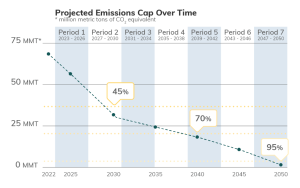
Under the cap-and-invest program, most businesses that emit more than 25,000 metric tons of carbon dioxide (CO2) equivalent (MT CO2e) annually must obtain allowances equal to their covered GHG emissions. The covered emissions are determined from businesses’ GHG reports to the Washington DoE, which are due by March 31 for the previous calendar year. Businesses can purchase allowances at quarterly DoE-hosted auctions, with the first auction held on February 28, 2023.


Project Emissions Cap Over Time
Washington’s cap-and-invest program sets a limit, or cap, on overall carbon emissions in the state and requires businesses to obtain allowances equal to their covered GHG emissions. (Source: Washington Department of Ecology)


These allowances can then be purchased or sold on secondary markets. In addition, some businesses will be issued no-cost allowances: emissions-intensive, trade-exposed industries (EITEs), natural gas utilities, and electric utilities. The first deadline for businesses to submit their emissions allowances and/or offset credits is November 1, 2024, to cover 30% of their 2023 emissions. Any business that can rapidly decarbonize its technology during the four-year compliance period would then be able to sell excess allowances that are not needed for compliance.

Inside Washington’s Clean Fuel Standard

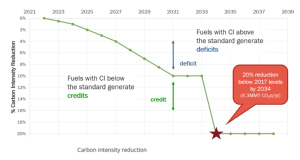
The Washington CFS is designed to work in tandem with the cap-and-invest program and the design structure is similar to California’s Low-Carbon Fuel Standard (LCFS) program. The Washington CFS requires fuel suppliers to reduce the carbon intensity (CI) of transportation fuels to 20% below 2017 levels by 2034. Some of the major exemptions from this program are aviation, marine, railroad locomotives, and military.


Washington Clean Fuel Standard
Under Washington’s Clean Fuel Standard, fuels will be assessed to determine their carbon intensity. Cleaner fuels – those with a carbon intensity below the standard – will generate credits that can be kept or sold to producers of high-carbon fuels. Fuels with a carbon intensity above the standard will generate deficits. (Source: Washington Department of Ecology)


Fuel suppliers may apply for a CI that is already approved by California’s Air Resources Board (CARB) or Oregon’s Department of Environmental Quality (DEQ), but it must be adjusted using Washington’s Greenhouse Gases, Regulated Emissions, and Energy Use in Transportation (GREET) model. Clean fuels with CI scores below the standard will generate credits that can be sold and fuels with CI scores above the standard will generate deficits that will need to be covered by purchasing credits.

EcoEngineers Is Here to Help

EcoEngineers is a consulting, auditing, and advisory firm with an exclusive focus on the energy transition. From innovation to impact, Eco helps its clients navigate the disruption caused by carbon emissions and climate change. Eco helps organizations stay informed, measure emissions, make investment decisions, maintain compliance, and manage data through the lens of carbon accounting. Its team of engineers, scientists, auditors, consultants, and researchers live and work at the intersection of low-carbon fuel policy, innovative technologies, and the carbon marketplace. Eco was established in 2009 to steer low-carbon fuel producers through the complexities of emerging energy regulations in the United States. Today, Eco’s global team is shaping the response to climate change by advising businesses across the energy transition.

For more information about the State of Washington’s cap-and-invest and Clean Fuel Standard programs, please contact us at clientservices@ecoengineers.us.

Asset Development — Stepping Into the Future

Asset DevelopmentAsset Development — Stepping Into the Future

A typical clean energy project development life-cycle is a complex process that requires a wide array of knowledge of technologies, markets, risk, implementation, construction, startup, and optimization.

This is where EcoEngineers can help. We understand that you are the pioneers who are risking capital and reaching for a better tomorrow. Our role is to be your trusted advisor on this journey to guide you through all phases of your project.

Our ready-made team of experts includes engineers, market analysts, and industry leaders who seamlessly complement your team’s expertise across all industries and project types — including biofuels and renewable energy, voluntary carbon markets, carbon removals, and sequestration, harnessing the new hydrogen economy, integrating electric vehicles (EVs) into your fleet, or evaluating global markets for your fuel or energy.

Our Services Across the Design, Build, and Operation Phases:

  • Feedstock Compliance
  • Technology Selection
  • Life-Cycle Analysis (LCA)
  • Techno-Economic Analysis (TEA)
  • Feasibility Studies
  • Regulatory Interpretations
  • Credit Market Analysis and Projections
  • Emerging Carbon Market Analysis
  • Investor Due Diligence
  • Compliance Reporting
  • Project Optimization

We bring expertise in global climate regulations, emerging incentive programs, new technologies, evolving carbon markets, data standards, energy credit markets, commodity markets, feedstocks, and carbon accounting rules. Our technical knowledge, industry connections, and market intelligence help you identify investment opportunities, conduct project feasibility and market studies, assess risk and propose risk mitigation strategies, techno-economic analysis, assess project partners, secure financing, and project due diligence, feedstock and offtake agreements, apply for incentive programs, and oversee construction and commissioning. We are a third-party consultant and do not take equity or a percentage of credits.

Eco has supported more than 200 asset development engagements and $4 billion of investments for projects across decarbonization projects and technologies.

Contact us to learn how we can help you analyze, develop, and implement renewable energy and sustainability projects to achieve your sustainability goals at clientservices@ecoengineers.us.

Inflation Reduction Act: Reflecting on One Year of Clean Energy Transformation

Inflation Reduction Act: Reflecting on One Year of Clean Energy Transformation

We’ve seen significant change since the passage of the Inflation Reduction Act (IRA) just one year ago. Focused on tackling the pressing challenges of climate change and soaring inflation, the IRA has mobilized unprecedented investments in clean energy across various sectors, including renewable fuels, electric vehicles, carbon capture, and energy efficiency initiatives. This article outlines the impact of the IRA, its potential for the future, how you can take advantage of the various incentives, and how EcoEngineers can help you navigate this change.

Driving the Clean Energy Revolution

The IRA was signed into law on August 16, 2022, signaling a new era for energy and environmental investments in the US. Since then, the U.S. Treasury Department has been releasing guidance in response to a barrage of questions from applicants keen to tap into the myriad of opportunities the IRA presents.

The energy-related tax credits in the IRA include:

  • 45Q – Provides a tax credit to qualified facilities of $85 per metric ton (/metric ton) of carbon dioxide (CO2) stored or $60/metric ton of CO2 used for enhanced oil recovery or other use. Plants built to capture CO2 from the air can get $180/metric ton. Projects have until January 2033 to begin construction.
  • 45Z – Provides a tax credit of up to $1 per gallon (/gal) for domestic production of clean transportation fuels between Dec. 31, 2024, and Dec. 31, 2027. Ethanol plants claiming credits under 45Z don’t have to sequester CO2; they can use it for other purposes.
  • 45V – Provides up to $3 per kilogram (/kg) of hydrogen produced with reduced greenhouse gas (GHG) emissions. The tax credits may be claimed for 10 years on hydrogen sold or used. Hydrogen is an ingredient in fertilizer and has other industrial uses.
  • 40B – Provides a credit of $1.25/gal of sustainable aviation fuel (SAF) in a qualified fuel mixture. SAF must have a baseline lifecycle GHG emissions reduction percentage of 50% compared to petroleum jet fuel. The regulation further incentivizes carbon intensity (CI) reduction by including an additional $0.01/gal tax credit for each percentage point above the 50% reduction for a maximum of $1.75/gal. (Note: The tax credit will not apply to fuel derived from co-processing with non-biomass feedstocks, palm fatty acid distillates, or petroleum.)
  • 48C – Provides $10 billion in credit for qualifying advanced energy products – $4 billion of which must go to projects in designated energy communities. To qualify for the credit, a project must re-equip an industrial or manufacturing facility for the production or recycling of numerous energy types, among other criteria. The first round of funding opens May 31, 2023, and initial concept papers are due July 31, 2023.
  • 48X – Provides tax credits for the production and sale of components related to solar PV modules, battery and energy storage components, and critical mineral sourcing and processing. The 45X credit will begin to phase out in 2030 and be completely phased out after 2033. Manufacturers cannot claim 45X credits for any facility that has claimed a 48C credit.

A Decade-Long Commitment with Lifelong Benefits

While the IRA extends and modifies various energy-related provisions and incentives for 10 years, the law’s true power lies in its ability to plant seeds of a low-carbon future that will grow for the next 30 to 40 years. By spurring investments in clean and renewable energies, the IRA is set to dramatically change how we produce and consume energy, reducing emissions from carbon-intensive and hard-to-abate processes such as cement, steel, and fertilizer production, to name a few.

Direct Pay and Transferability 

Under the IRA, certain taxpayers may elect for a direct payment in lieu of a tax credit or make an election to transfer all or a portion of an eligible credit to an unrelated taxpayer. This allows non-profits, state and local or tribal governments, and rural cooperatives that don’t have an income tax to be eligible to claim clean energy tax credits. For-profit entities like smaller developers who don’t have a large income tax obligation can transfer or sell the tax credits to an unrelated entity. This rule solves the inefficiencies of traditional tax equity financing and is anticipated to bring more liquidity to clean energy projects. 

Decarbonization Potential Unleashed

By incentivizing clean energy initiatives across a host of industries, the passage of the IRA, in combination with the Bipartisan Infrastructure Law signed into law in November 2021, could achieve a 35%-41% reduction in economy-wide GHG emissions below 2005 levels by 2030 over its lifetime, according to the U.S. Department of Energy (DOE). The Biden administration estimates that the clean energy provisions of the IRA and the Bipartisan Infrastructure Law together could reduce emissions by more than 1 billion tons of CO2e in 2030, equivalent to the combined annual emissions released from every home in the United States.

Taking Advantage of the Incentives

The tax code can be a challenge to read. Below are just a few resources to help you unravel the IRA:

  • Visit IRAtracker.org and look at it through the lens of your existing business and GHG reduction goals. The tracker, which is linked to the IRA database, lays out details about the types of projects eligible for incentives to help you determine whether the opportunities meet your needs.
  • Check out the “Understanding the IRA hub” developed by the Environmental Defense Fund (EDF) in partnership with Deloitte to see if any of the use cases fit your company’s needs.
  • Visit Invest.gov, which lists businesses making investments supported by the IRA, Bipartisan Infrastructure Law, and CHIPS and Science Act.

About EcoEngineers

EcoEngineers is a consulting, auditing, and advisory firm with an exclusive focus on the energy transition. From innovation to impact, Eco helps its clients navigate the disruption caused by carbon emissions and climate change. Eco helps organizations stay informed, measure emissions, make investment decisions, maintain compliance, and manage data through the lens of carbon accounting. Its team of engineers, scientists, auditors, consultants, and researchers live and work at the intersection of low-carbon fuel policy, innovative technologies, and the carbon marketplace. Eco was established in 2009 to steer low-carbon fuel producers through the complexities of emerging energy regulations in the United States. Today, Eco’s global team is shaping the response to climate change by advising businesses across the energy transition.

For more information about EcoEngineers’ role in helping interested parties participate in the IRA, contact us at clientservices@ecoengineers.us.

Three Things Hydrogen Project Developers Can Do Now Ahead of Treasury Department Guidance

45V Hydrogen Tax Credit Rules Delayed: Three Things Project Developers Need to Know Ahead of Anticipated Treasury Department Guidance

Find out what steps project developers can take now amid the Treasury Department’s anticipated delay in issuing guidance on the 45V hydrogen tax credit.

By Tanya Peacock, Managing Director, California and Hydrogen

Clean hydrogen is key to reducing emissions, particularly from hard-to-abate sectors like the steel, cement, fertilizer, and chemicals industries, as well as transportation. Signed into law last year, the Inflation Reduction Act (IRA) includes potentially more than $100 billion of tax incentives over its lifetime for project developers to seize on and set in motion the nascent clean hydrogen economy on a path for rapid growth.

The IRA requires emissions from hydrogen production to be less than 0.45 kg CO2e/kg to qualify for the full ($3.0/kg) 45V clean hydrogen production tax credit and must be 4 kg CO2e/kg or lower on a well-to-gate life-cycle basis to quality for partial credit. This 10-year tax credit is extremely valuable and represents a substantial share of the economic proposition for clean hydrogen production.

READ MORE: Clean Hydrogen Fuel Has Important Potential for Decarbonization Goals

The IRA requires the U.S. Treasury Department to publish guidance for calculating the lifecycle greenhouse gas (GHG) emissions of hydrogen projects within one year of its enactment. Because the law was signed on August 16, 2022, that deadline is unlikely to be met. According to media reports, Treasury Department guidance for the 45V hydrogen tax credit is not expected to come out until October and may be as late as December, potentially missing the deadline by as much as four months.

What Can Hydrogen Project Developers Do Now?

So, what can project developers do now to keep their hydrogen projects on track amid the anticipated delayed guidance from the Treasury Department on the 45V hydrogen tax credit? Below are recommendations on what hydrogen project developers can do now to be prepared and how EcoEngineers can help you gain full benefit and monetization of the 45V hydrogen tax credit.

  1. Know the Base Case Carbon Intensity (CI) Score of Your Planned Project
    A CI score is the aggregated GHG emissions during the life cycle of a fuel divided by the quantity of the fuel. To qualify for the 45V hydrogen tax credit under the IRA, developers will need a Life-Cycle Assessment (LCA) to determine if the hydrogen has a CI score of 4 kg CO2e/kg of hydrogen or lower on a well-to-gate basis. An LCA should be conducted by experts as early as possible in the project development cycle using the correct model(s) with the correct inputs. Sensitivity analyses can be run based on various 45V scenarios to help manage risk and guide investment decisions. If your actual CI is higher than originally expected, millions of dollars could be lost.

  2. Understand All Regulatory and Permitting Requirements (And Value Streams)
    While waiting for 45V guidance, project developers should consult with appropriate experts for a thorough review of all regulatory and permitting application and compliance requirements. Understanding and potentially lining up required approvals, inspections, and reviews will help ensure the product can be sold to the intended parties and facilitates claiming essential credits. Additionally, a regulatory plan can include an evaluation of credits and incentives available for the project.

  3. Conduct a Due Diligence Study on Selected Technology
    Take the time to review the process performance demonstration run data provided by your technology vendor. Are the claims of the product quality, process operability (days on stream/year), emissions levels, and operating costs accurate? Having a third-party expert review your process performance guarantee now could save you millions of dollars in the future.

EcoEngineers has performed more than 500 LCAs since 2015. We have experience in all the regulations that require LCAs, including the U.S. Renewable Fuel Standard (RFS), California Low-Carbon Fuel Standard (LCFS), Oregon Clean Fuels Program (CFP), Canada Clean Fuel Regulations (CFR), British Columbia Renewable and Low-Carbon Fuel Requirements (RLCFR), Brazil RenovaBio, EU Renewable Energy Directive (RED) and impending directives, along with emerging Voluntary Carbon Markets.

READ MORE: Life-Cycle Analysis and Clean Hydrogen Consulting

With more than 200 asset development engagements and $4 billion of investments for projects across decarbonization projects and technologies, Eco’s team of experts can provide individualized guidance throughout the entire project development lifecycle of your hydrogen project. From design, build, and operational phases to regulatory and permitting guidance, technology and market risk assessments, startup optimization, and capital raising evaluations – we have you covered.

For more information about our clean hydrogen services, contact:

Tanya Peacock
Tanya Peacock


Tanya Peacock, Managing Director, California and Hydrogen | tpeacock@ecoengineers.us

The Importance of Carbon Intensity and Compliance to Meet Decarbonization Goals

The following is an article originally published in July 2023, by CEP.

The Importance of Carbon Intensity and Compliance to Meet Decarbonization Goals

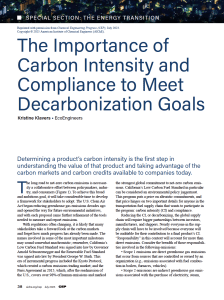
The road to net-zero for companies and society is long and requires a collaborative effort between policymakers, industry experts, and consumers. Incremental progress has been made in policy and the carbon markets through California’s Low-Carbon Fuel Standard (LCFS) and the Renewable Fuel Standard (RFS) but there’s plenty more that can and should be done. In her most recent article published in Chemical Engineering Progress (CEP), an American Institute of Chemical Engineers (AiChe) publication, Kristine Klavers details how the global supply chain can achieve this broad and ambitious goal of net-zero emissions by leveraging carbon markets, establishing credible carbon reduction, knowing your carbon intensity (CI) score, and monetizing carbon-reduction efforts.

Click the thumbnail above to read the full article.


For more information about our oil and gas services, contact: Kristine Klavers, Managing Director, Houston, Petroleum and Refining| kklavers@ecoengineers.us

A Renewable Fuels Entrepreneur Checklist: 10 Critical Factors for Project Success

A Renewable Fuels Entrepreneur Checklist: 10 Critical Factors for Project Success

Find out what early-stage renewable fuel, biochemicals, hydrogen, and CCUS project developers need to know to avoid pitfalls on their path to commercialization.

By Ed Arnold, Director, Asset Development

Far too many entrepreneurial renewable fuels, clean hydrogen, biochemical, and carbon capture, utilization, and sequestration (CCUS) firms never pass the finish line. Shifting markets, recessions, evolving and complex regulations, hiring managers with the appropriate experience, finding patient investors, and the difficulties associated with developing projects based on cutting-edge, unproven process technology present significant challenges.

Looking back upon the renewable fuels projects I have reviewed over the last 20 years, I see considerable repetition regarding issues that are often the cause of stumbles. My summary of the top 10 reasons for failure or lengthy delays, along with some suggestions for risk mitigation, are summarized below.

  1. Underestimating Capital Cost (CapEx) and Operating Cost (OpEx)
    • Poor CapEx estimations are a common error for renewable fuel entrepreneurs. Some will start with a maximum project cost target that will still allow them to achieve an attractive return on investment (ROI) and assume that innovation, hard bargaining, excellent project management, and hard work will get them to that number. In addition, I have seen absolute faith in project capital cost estimates delivered by process technology providers or engineering firms delivering early-stage work — both of which have the incentive to lowball total installed cost estimates for projects.
    • This issue can usually be avoided by comparing the planned project to reasonable estimates of actual final costs for similar projects and using established total installed cost curves for all major project items, something that independent, experienced consultants can help entrepreneurs develop. Although they have downsides, asking for lump sum turnkey (LSTK) bids is another approach that can be used to firm up realistic total installed cost estimates.
    • Additionally, underestimating OpEx occurs frequently with new plants and novel processes. Common culprits are underestimating catalyst costs, operational labor requirements, or facility maintenance costs.
    • The solution: Engage experts early in the feasibility stage who have run similar facilities to get a dose of reality injected into the cost estimates.
  2. Skipping Process Demonstration
    • For a new process technology, it’s essential to move from the pilot stage to an intermediate process demonstration stage before scaling to a commercial-scale facility. Otherwise, your first commercial run usually becomes a costly process development run. All established renewable fuel process development firms know this.
    • The record of entrepreneurial renewable fuels business development history is littered with the memories of firms that thought they could go directly from pilot plant runs to successful commercial design and then complete a quick start-up. This behavior is sometimes reinforced by their engineering, procurement, and construction (EPC) firm. Every entrepreneur should review the long history of successful and unsuccessful new process technology development for renewable fuel production. They also need to understand that process development and process scale-up are two different subjects.
  3. Early-Stage Vetting of Carbon Intensity (CI)
  4. Supply and Offtake Agreements
    • I often see gaps between feedstock supply and offtake agreements that predict declining margins in the future. This can be and should be avoided. Entrepreneurs should engage experts who understand the intricacies of price basis indexes and who can provide defendable, scenario-based feedstock cost and product value price forecasts, as well as suggestions for hedging against margin shrinkage.
    • In addition, I have seen offtake agreements with durations of two to five years, when the payback for the investment will be much longer. Their ultimate lenders will not find that attractive.
  5. Underestimating Project and Process Timelines
    • Full project schedules are often underestimated, sometimes by years. Get advice from a knowledgeable expert at an early stage in the project. Understanding the time requirements for permitting, environmental studies, geotechnical work, site preparation, and the local availability of all required construction skill sets is essential for developing a realistic estimate.
    • A seasoned project development professional will also be able to help entrepreneurs de-risk their project schedules.
  6. Underestimating Production Volumes
    • Project developers often use optimistic projections of production volumes in their financial models and promotional materials. These volumes often never come to fruition.
    • The solution is to confer with process design and development experts and to base process yield expectations based on longer-term demonstration plant runs and rigorous heat and material balances.
  7. Long-Duration Testing for Corrosion and Fouling
    • One of the typical problems for renewable fuels projects is that the project developers may not understand that high-impact fouling and corrosion issues may not show up for many weeks or even months after a first commercial demonstration test run has begun.
    • A demonstration run that lasts a week or two will usually not answer all the outstanding questions. Have an expert help set up and monitor your run. This will pay dividends in the long run.
  8. Process Development, Project Management, Facility Management, and Operations Management
    • Owners should select process, project, facility, and operations managers that have proven, hands-on experience in the field of work. Proven experience with the core process technologies that will be used in the current project is a plus. Proven ability to select successful operations, maintenance, health, safety, environmental (HS&E), compliance, and planning supervisors is a necessity. If first-of-a-kind process technology is to be used, experience with going through a first-of-a-kind process start-up is a plus.
  9. Understanding All Regulatory and Permitting Requirements
    • Too often, I have seen an owner get very close to a start-up and then suddenly realize that they could not sell their product to the intended parties or claim essential credits because of a lack of required approvals, inspections, reviews, etc. These planning oversights are sometimes the result of bad advice and sometimes it is simply an error of omission. Owners should consult with appropriate experts at an early stage in the project planning process to ensure a thorough review of all regulatory and permitting requirements is vetted and completed.
  10. Material Balance Issues
    • A material balance is a quantitative accounting for all mass entering and leaving a process system, showing that the total weight entering a plant comes very close to the total weight going out. Building this balance is a method for ensuring that all products produced from a process system are accounted for.
    • I too often encounter or hear of a process development entrepreneur who, sometime during their first long-term demonstration run or first commercial-scale process run, is surprised by the behavior of a previously unaccounted-for-byproduct in their process.
    • The consequences are often significant. Some examples are (a) the discovery of significant fouling in or after a reactor or a process heat exchanger, (b) the underestimation of solvent, adsorbent, or catalyst consumption rates, or (c) the discovery that a compound, previously unaccounted for and eventually determined to be toxic, explosive, or a long-duration greenhouse gas (GHG), is off-gassing from a collected major liquid product, or a solid-phase reaction byproduct.
    • Many of these issues resulted in unfortunate consequences for the entrepreneurs. Nearly all could have been avoided if the process/project developers had invested in the proper measurement-enabling equipment and had taken the time to perform rigorous material balances during their pilot plant or process demonstration runs. However, for some entrepreneurs, this level of detail is often viewed as optional, too expensive, or simply unnecessary. For experienced process developers, closing material balances is a must.

EcoEngineers: Your End-to-End Guide

In summary, setting project costs, schedules, and performance expectations and making decisions based on the knowledge of individuals who have proven experience in the renewable fuels industry will prevent costly mistakes and delays. Choosing experienced personnel who know how to manage your entire EPC project phase, selecting and training your operations staff, and then starting up and operating your facility, will also be a wise investment.

This is why engaging proven regulatory and permitting experts like those at EcoEngineers early in the project cycle, to help guide you through the regulatory and permitting jungle, can save you millions in lost revenue.

We provide valuable services and capabilities to renewable fuels start-up companies with experience-based guidance to help them navigate the challenges of the industry. Whether it’s comparing project costs to realistic estimates or evaluating the feasibility of novel process technology and communicating that to your investors, we can help.

For more information about our Asset Development services, please contact:

renewable fuels


Ed Arnold, Director, Asset Development | earnold@ecoengineers.us